Generative Engine Optimization: Earn Citations in AI Search
Learn practical generative engine optimization strategies to improve retrieval, verify claims, earn AI search citations, and measure GEO performance.

Original illustration by GeniuzQuiz
Generative engine optimization (GEO) is the practice of making web content easy for AI search systems to retrieve, understand, verify, and cite. To earn citations in ChatGPT, Perplexity, Gemini, and Google AI Overviews, publish answer-first passages, support claims with primary evidence, clarify entities, maintain crawlability, and measure citation frequency—not rankings alone.
A useful GEO principle is simple: a page earns citations when an AI system can find the right passage, identify what it claims, verify why the claim is credible, and reuse it without changing its meaning.
Key takeaways
- Write self-contained answers that make sense when extracted from the rest of the page.
- Use named entities, precise terminology, dates, units, and source context instead of vague claims.
- Pair original evidence with clear methodology so AI systems can distinguish your contribution from recycled advice.
- Keep important content crawlable, indexable, current, and available in the rendered HTML.
- Track citation share, cited URLs, answer inclusion, assisted conversions, and branded search—not rankings alone.
- Use the TRACE framework: Thesis, Retrieval, Attribution, Context, and Evaluation.
What is generative engine optimization?
Generative engine optimization is a content and technical publishing discipline designed to increase a source's visibility inside AI-generated answers. Traditional search engine optimization usually focuses on ranking a page in a list of results. GEO focuses on whether an answer engine retrieves a passage, trusts it enough to use, and attributes the resulting statement to the publisher.
The two disciplines overlap substantially. Search engines and generative engines both benefit from accessible pages, descriptive headings, strong internal architecture, reputable links, original information, and satisfied users. Google has also stated that pages appearing in its AI search features remain subject to established search requirements and do not need special AI markup. Sound SEO is therefore the foundation of GEO, not a competing activity.
The difference is the unit of competition. A conventional result may win because the complete page best satisfies a query. An AI answer may be assembled from several passages across multiple domains. One source can define a concept, another can supply statistics, and a third can provide an example. Your paragraph must compete as a usable evidence unit even when the engine does not need your whole article.
| Dimension | Traditional SEO | Generative engine optimization |
|---|---|---|
| Primary objective | Earn qualified organic rankings and clicks | Earn inclusion, mentions, citations, and qualified visits from generated answers |
| Common unit of evaluation | Page, domain, link profile, and user intent | Passage, claim, entity, source, and query context |
| Typical output | Blue link, rich result, local result, or featured snippet | Synthesized answer with links, footnotes, source cards, or brand mentions |
| Content advantage | Comprehensive satisfaction of search intent | Extractable answers backed by differentiated evidence |
| Core measurements | Rankings, impressions, clicks, and conversions | Citation share, answer inclusion, cited-page traffic, mentions, and assisted conversions |
GEO does not guarantee that a model will quote or link to a page. Generated answers are probabilistic, query-dependent, and influenced by changing retrieval systems. Citations can also differ by location, account, model, search mode, and day. The practical objective is to increase citation eligibility and observed citation frequency across a stable query set.
Research supports treating GEO as more than keyword placement. The academic paper that popularized the term, later presented at KDD 2024, tested methods such as adding citations, quotations, statistics, and clearer language. It reported visibility gains of up to 40 percent for some methods and domains in its experimental setting. That figure describes visibility within the study's generated responses; it should not be interpreted as a universal traffic increase.
How do AI search engines choose sources to cite?
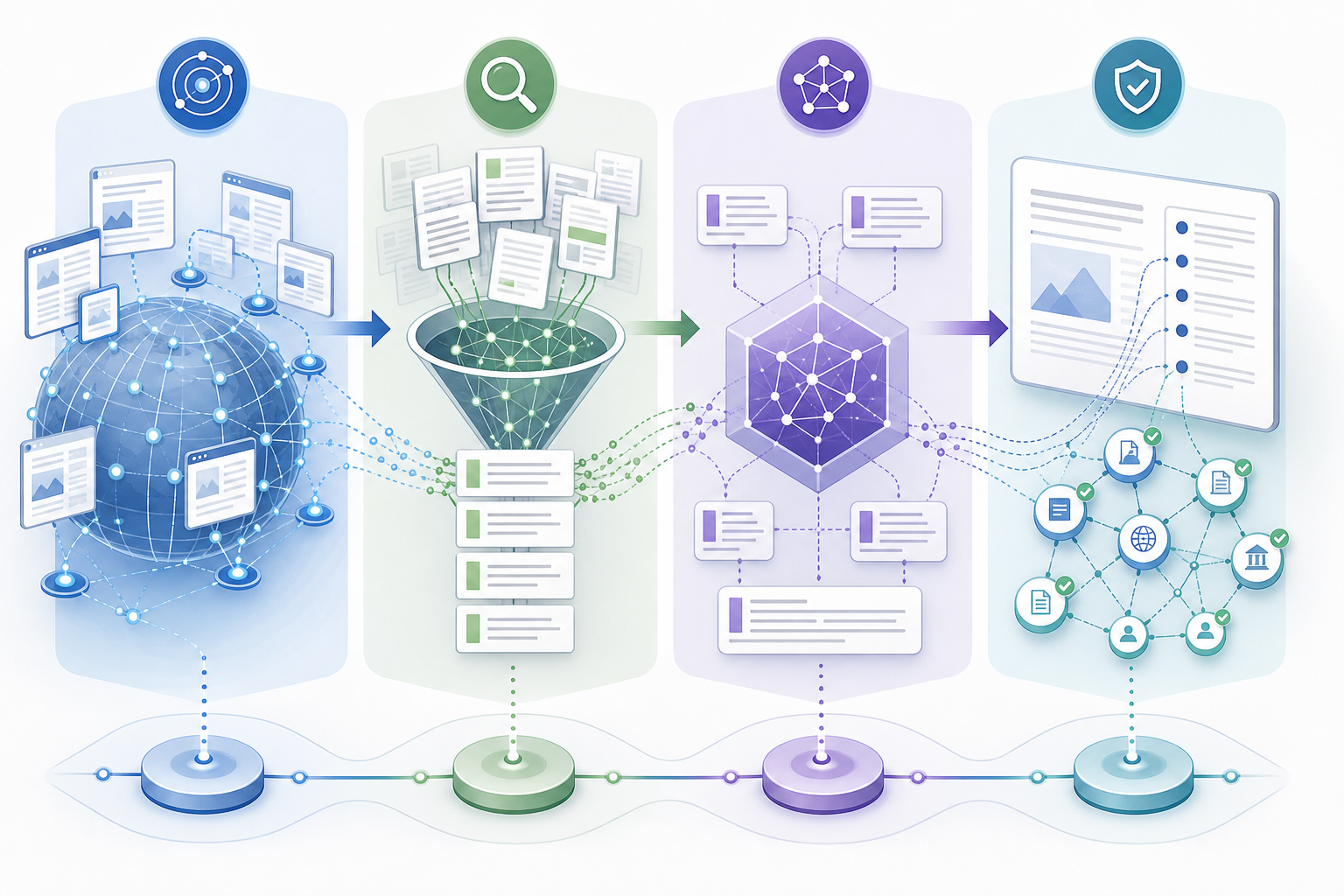
AI search products use different indexes, crawlers, retrieval methods, ranking systems, and language models. Their exact selection mechanisms are proprietary. However, observable behavior and published technical guidance indicate that citation selection generally depends on four stages: discovery, retrieval, synthesis, and attribution.
Discovery and access
The system must first discover and process the page. Important answers should be available in server-rendered or reliably rendered HTML, linked from relevant pages, included in sensible site architecture, and not blocked unintentionally. Canonical tags, redirects, robots directives, authentication barriers, and noindex settings can all change eligibility.
Publisher controls vary by platform. Search crawlers, training crawlers, and user-triggered agents may have different names and purposes. A rule aimed at model training does not necessarily control live search retrieval, while blocking a search crawler can reduce citation opportunities. Because bot documentation changes, audit current first-party documentation before changing robots.txt or firewall rules.
Passage retrieval
After discovery, the engine attempts to retrieve passages relevant to the prompt. Exact keyword repetition is not required, but explicit language helps. A passage about quiz funnel completion should say what completion rate means, identify the funnel stage, and name any relevant acquisition channel, such as Meta ads. A paragraph filled with pronouns, slogans, or unexplained references gives a retrieval system fewer reliable signals.
Question-style headings can align a passage with conversational prompts. They are useful when they reflect real information needs, not when every heading is mechanically rewritten as a question. Definitions, comparisons, procedures, limitations, and numerical benchmarks are especially reusable answer patterns.
Synthesis and corroboration
The model then combines retrieved information. Claims supported by primary evidence, consistent facts, or multiple credible sources are easier to synthesize than isolated assertions. This does not mean repeating a popular consensus is enough. A source becomes more valuable when it contributes a fact, framework, dataset, test result, or practitioner observation that other pages do not provide.
Corroboration also depends on entity clarity. State the full name of a company, platform, metric, methodology, or standard before using an abbreviation. Distinguish Google AI Overviews from Gemini, and distinguish a quiz funnel from a conventional lead-generation form. These details reduce the risk that the engine merges unrelated concepts.
Attribution and presentation
A generated answer may cite the source used for a specific sentence, display a group of supporting links, or mention a brand without a clickable attribution. The cited source is not always the original source. An aggregator can be selected when it explains the evidence more clearly or is easier to retrieve than the primary publication.
Publishers can reduce that risk by placing the original finding, date, sample, method, and limitation together. For example, do not write only that interactive lead magnets convert better. Explain that a specific team compared a quiz funnel with a static form, identify the traffic source and date range, define conversion, provide sample sizes, and disclose whether audience targeting changed. That compact evidence package is more attributable.
What is the TRACE framework for earning AI citations?

TRACE is our five-part citation-readiness framework: Thesis-first answers, Retrieval access, Attributable evidence, Context-rich entities, and Evaluation loops. It turns GEO from an abstract writing tactic into a checklist that editorial, SEO, analytics, and product teams can apply before and after publication.
T: Thesis-first answers
Lead each important section with the conclusion a reader came to find. The opening sentence should answer the heading before providing background. This structure serves impatient readers, featured snippets, and retrieval systems at the same time.
A thesis-first passage should usually identify the subject, action, and condition. Instead of writing, “There are many factors marketers may wish to consider,” write, “A quiz funnel should ask only questions that change the recommendation, segmentation, or follow-up.” The second version can stand alone and creates a testable editorial rule.
R: Retrieval access
Confirm that engines can fetch, render, index, and locate the answer. Check the canonical URL, status code, robots directives, internal links, structured page hierarchy, mobile rendering, and JavaScript dependencies. Keep core explanatory copy out of images, videos, pop-ups, and interactions that require user input.
Retrieval also has an architectural dimension. Connect an authoritative overview to narrower pages covering definitions, implementation, examples, and measurement. Use descriptive anchors rather than generic phrases. A coherent cluster helps a system infer which page is the main reference and which pages provide supporting detail.
A: Attributable evidence
Make every material claim traceable. Favor first-party tests, product data, official documentation, peer-reviewed research, standards, and clearly identified expert experience. Record who collected the data, what was measured, when it was measured, and what limitations apply.
When you cite secondary research, do not inflate its conclusion. A correlation is not proof of causation, an experimental visibility score is not revenue, and one campaign is not a universal benchmark. Accurate qualification builds trust and gives answer engines language they can repeat safely.
C: Context-rich entities
Names and relationships are retrieval handles. Include the full entity name, category, relevant attributes, and relationship to the claim. “The platform improved results” is weak. “The Google AI Overview displayed supporting sources for this informational query” identifies the product, feature, output, and query type.
Context also means defining metrics. A conversion rate could refer to ad click to lead, quiz start to completion, completion to email opt-in, or lead to sale. Specify the numerator and denominator. If a quiz receives 1,000 starts and 620 completions, its start-to-completion rate is 62 percent. Such statements are both human-readable and machine-extractable.
E: Evaluation loops
Test prompts repeatedly, record citations, inspect referral traffic, and update weak passages. GEO is not complete at publication because source selection and generated interfaces change. Evaluation distinguishes a plausible optimization from a tactic that actually increases qualified visibility.
Use a fixed prompt panel so results remain comparable. Run tests in consistent locations and modes, note personalization, and repeat them on a schedule. A single screenshot is anecdotal evidence. A monthly sample across 50 commercially relevant prompts can reveal patterns.
How do you create content that AI engines can cite?
Start with a real information gap rather than adding generic copy to an existing keyword target. Search results often contain dozens of pages restating the same definitions. Another summary offers little reason for an answer engine to select a new source. Original research, operational detail, precise examples, and explicit tradeoffs create a stronger citation proposition.
Step 1: Build a prompt and intent map
Keyword volume does not capture every conversational query. Collect prompts from sales calls, customer support tickets, community discussions, Search Console queries, onsite searches, and the questions prospects ask before purchasing. Include short queries and multi-constraint prompts.
For a quiz-funnel business, a prompt map might contain “What is a quiz funnel?”, “How many questions should a lead-generation quiz have?”, “Quiz funnel versus landing-page form,” and “How do I track a quiz lead from Meta ads to a sale?” Group prompts by intent: definition, comparison, procedure, troubleshooting, evidence, and purchase evaluation.
Assign one primary page to each cluster. Avoid creating many near-identical pages for slight wording variations. A comprehensive page can answer related subquestions with distinct sections while preserving one clear subject.
Step 2: Gather evidence before drafting
Create an evidence sheet containing primary sources, official statements, internal observations, definitions, dates, and limitations. Separate what is known from what the team believes. If you cannot support a number, remove it or label it as an internal directional result rather than presenting it as an industry benchmark.
Practitioner evidence can be valuable when the method is transparent. As teams that ship quiz funnels, we would document the traffic source, quiz version, question count, result logic, lead magnet, follow-up sequence, sample size, and conversion definition before publishing a test. This makes the observation auditable and helps another practitioner judge whether it applies to their funnel.
Step 3: Write extractable answer blocks
An answer block should address one question in roughly one to three focused paragraphs. Begin with the direct answer, define unfamiliar terms, and then add evidence or exceptions. Do not force every block to the same length; completeness matters more than an arbitrary word count.
Use lists for procedures, requirements, or categories. Use tables when readers need to compare options across shared criteria. Place caveats beside the claim they qualify rather than hiding them hundreds of words later. If an engine extracts only the central passage, it should retain the conditions necessary to interpret the answer correctly.
A strong answer block often includes:
- A declarative answer using the same entities named in the question.
- A concise explanation of why the answer is correct.
- A source, method, example, or calculation supporting the claim.
- A condition or exception that prevents overgeneralization.
- A next action when the query has procedural intent.
Step 4: Add information gain
Information gain is the useful contribution your page adds beyond what is already available. It may come from proprietary data, a new taxonomy, an expert workflow, a decision rule, a calculator, a failure analysis, or a well-documented experiment.
The TRACE framework in this article is an example of a reusable synthesis. Its value depends on whether each component leads to concrete editorial and technical checks. Merely inventing an acronym is not information gain. The framework must compress experience into a clearer decision process.
For original data, publish enough methodology to make the result interpretable. Include the sample source, sample size, collection window, exclusions, metric formula, and relevant confounders. If privacy prevents releasing raw quiz-funnel records, provide aggregated data and explain the threshold used to suppress small segments.
Step 5: Demonstrate experience without turning the page into a sales pitch
Firsthand detail supports E-E-A-T when it helps readers make a decision. Explain what failed, which constraint mattered, and how the team validated the fix. A shallow statement such as “personalization boosts engagement” is less useful than explaining that recommendation logic should use answers that materially change the result, while cosmetic branching adds maintenance without improving relevance.
Product mentions should be contextual. GeniuzQuiz builds quiz funnels that segment leads and deliver tailored outcomes; readers can examine its features or adapt starting points from its templates. That reference is useful in an implementation example, but it should not replace independent instruction.
Step 6: Strengthen entity and topic signals
Use consistent terminology throughout the page. Define GEO before switching to the abbreviation. Name Meta ads rather than writing only “paid social,” and identify AI Overviews as a Google Search feature rather than treating the phrase as a generic category.
Cover adjacent concepts only when they clarify the main answer. A section about citation measurement belongs in a GEO guide. A broad history of artificial intelligence probably does not. Topical completeness means resolving the user's next questions, not maximizing the number of loosely associated entities.
Step 7: Perform a citation-readiness edit
Review the page passage by passage rather than only reading it from top to bottom. Ask whether each important section has a direct answer, named subject, supporting evidence, clear date context, and nearby qualification. Remove unsupported superlatives and replace vague references such as “this,” “they,” or “recently” when the referent could be unclear outside the full page.
Then test extractability. Copy a paragraph into a separate document without its surrounding section. If a knowledgeable reader cannot identify the topic, source, or meaning, revise it. This simple test approximates the challenge faced when a retrieval system selects only a fragment.
Step 8: Maintain the source
Set review intervals according to volatility. Crawler controls and AI product interfaces may need quarterly review. Stable definitions can be checked annually. Pricing, platform features, and legal requirements should be reviewed whenever the underlying source changes.
Display meaningful updated dates only after substantive review. Changing a date without correcting obsolete facts erodes trust. Keep a private change log recording revised claims, replaced sources, methodology changes, and retired recommendations.
How should you measure generative engine optimization?
No single GEO metric is sufficient. Referral traffic undercounts visibility because many users receive their answer without clicking, and analytics attribution can be incomplete. Citation counts also vary across repeated generations. Use a portfolio of visibility, engagement, business, and quality indicators.
Track citation share across a controlled prompt set
Create a panel of prompts representing the customer journey and classify them as informational, comparative, commercial, or troubleshooting. For each engine and test date, record whether your domain was cited, which URL appeared, the citation position or presentation, competing domains, and whether the brand was mentioned without a link.
Calculate citation share as the number of eligible prompt responses citing your domain divided by the total responses tested. If your domain appears in 18 of 60 tested responses, citation share is 30 percent for that sample. Do not present it as a market-wide share unless the prompt set is representative and independently designed.
Separate citation frequency from citation quality
A citation for an irrelevant prompt can create impressions without business value. Weight prompts by strategic importance or report separate groups. A B2B software company may value a citation for “best quiz funnel software for lead segmentation” more than a citation for a broad definition that rarely leads to product evaluation.
Inspect whether the generated statement represents your source accurately. Record unsupported attribution, outdated facts, and citations that point to the wrong page. A rising citation count accompanied by frequent misrepresentation indicates that the content needs clearer scope or definitions.
Measure visits and downstream outcomes
Monitor referrers from AI search products where available, landing-page sessions, engaged sessions, conversions, and assisted conversions. Preserve referral information in analytics and annotate interface changes that may alter tracking. Ask leads how they discovered the brand because dark traffic can conceal AI-assisted discovery.
For quiz funnels, connect the cited landing page to quiz starts, completion, opt-in, qualified-lead rate, booked calls, and revenue. Evaluate the full path rather than celebrating low-intent visits. Teams considering implementation costs can compare platform pricing with the value of qualified leads and the operational cost of maintaining custom logic.
Watch leading indicators
Leading indicators include growth in branded search, new links to original research, passage-level impressions, crawler activity, and citations from conventional publishers. These signals do not prove that GEO caused growth, but they help explain changes when viewed alongside publication and testing dates.
Use a monthly dashboard and a quarterly interpretation cycle. Monthly tracking detects movement; quarterly analysis provides enough observations to separate persistent gains from generation variability. Document query, model, mode, location, account status, and test date so another analyst can reproduce the procedure.
How can quiz funnels create evidence worth citing?

Quiz funnels can generate original insight because they capture structured responses before delivering a recommendation, lead magnet, or product path. However, raw answer data is not automatically credible research. The questions, audience, acquisition source, consent process, and analysis method determine what can responsibly be concluded.
A useful dataset might examine which stated challenges correlate with quiz completion or which recommendation categories produce higher qualified-lead rates. A weak claim would generalize the preferences of a narrowly targeted Meta ads audience to all buyers. The publication should describe the audience and avoid implying causal relationships when the design shows only association.
Design the data collection around a decision
Ask questions that affect segmentation, recommendations, qualification, or follow-up. Every additional question introduces completion friction and potential bias. Before adding a field, identify who will use it and what action will change because of the response.
Keep research questions separate from essential lead-generation questions when possible. If a question exists only to produce an interesting statistic, disclose that purpose and consider whether respondents reasonably expect their aggregated answers to be analyzed.
Publish a compact methodology
A citable quiz-funnel finding should include the quiz topic, recruitment channel, field dates, number of starts and completions, question wording, exclusions, response options, and calculation method. State whether respondents could select multiple answers and whether percentages are based on starts, completions, or qualified leads.
For example: “Among 842 completed responses from a Meta ads campaign targeting United States small-business owners between April and June, 47 percent selected lead quality as their primary funnel problem.” This statement identifies the sample, audience, channel, period, denominator, and result. It still requires a warning that the targeted sample may not represent all small businesses.
Protect privacy and avoid false precision
Aggregate results, suppress small cells, and remove details that could identify respondents. Obtain appropriate consent and follow applicable privacy requirements. Round percentages when sample sizes do not justify decimal-level precision. A finding reported as 47 percent is usually more honest than 47.13 percent when campaign targeting and self-selection already limit generalization.
GeniuzQuiz can be used to build the quiz-funnel experience, but the publisher remains responsible for sound question design, consent, analysis, and claims. The strongest GEO asset is not the interactive format alone; it is the transparent, useful evidence produced through that format.
Frequently asked questions
Is GEO replacing SEO?
No. GEO extends SEO to generated answers rather than replacing it. Crawlability, indexability, internal links, authority, relevance, and helpful content still influence whether a source can be discovered and trusted. GEO adds passage-level extractability, explicit evidence, entity clarity, citation monitoring, and optimization for conversational prompts.
Can I guarantee a citation in ChatGPT or Google AI Overviews?
No publisher can guarantee an organic citation. Source selection varies by query, system, location, retrieval index, model, and time. You can improve eligibility by making content accessible, directly relevant, attributable, current, and easy to extract, then measure how often it appears across repeated tests.
Does schema markup make AI engines cite a page?
Schema markup can help search systems understand eligible content and entities, but it does not guarantee citation or ranking. Use structured data when it accurately represents visible page content and follows the relevant platform guidelines. Do not add unsupported review scores, authors, dates, or claims solely to attract AI systems.
How long should a GEO article be?
There is no universal length. The article should be long enough to answer the core query, resolve necessary follow-up questions, document evidence, and explain limitations without adding repetitive text. A concise primary-source page can be more citable than a long guide if it contains the exact evidence the engine needs.
How often should I test AI citations?
Monthly testing is a practical baseline for a stable prompt panel, with additional checks after major content updates or platform changes. High-value, volatile categories may justify weekly samples. Use several repeated observations because one generated response cannot establish a reliable trend.
Should I optimize for AI crawlers separately?
Audit crawler access separately because platforms may distinguish search retrieval, training, and user-requested agents. However, avoid creating a different low-quality version solely for bots. Important content should remain consistent for users and search systems. Review current first-party bot documentation before making access decisions.
What type of content earns the most useful AI citations?
The most useful citations usually come from content that resolves a specific question with traceable evidence: original datasets, official documentation, clear definitions, comparison tables, expert procedures, calculations, and transparent case studies. The commercial value depends on query intent, so measure qualified visits and conversions alongside raw citation frequency.
What is the fastest way to improve an existing page for GEO?
Rewrite each important section so its first sentence directly answers the heading, then add source context, named entities, dates, definitions, and limitations. Confirm that the page is crawlable and internally linked. Finally, test the relevant prompts before and after revision using the same engines and conditions. This will not guarantee citations, but it creates a measurable improvement process.