Product Recommendation Quiz for Shopify That Converts
Build a Shopify product recommendation quiz that guides choices, captures zero-party data, and lifts conversion rate, AOV, and qualified leads.

Original illustration by GeniuzQuiz
A product recommendation quiz for Shopify is an interactive guided-selling flow that asks shoppers about their needs, constraints, and preferences, then matches them to a small set of relevant products. To build one that converts, map answers to purchase criteria, reduce choice overload, explain every recommendation, and measure revenue after completion.
Our MATCH framework: define the Market goal, structure product Attributes, Triage shoppers with decisive questions, establish Confidence in the result, and create a measurable Hand-off to product pages, carts, email, and advertising. A quiz is effective only when all five parts work together.
Key takeaways
- Use a recommendation quiz when shoppers need help comparing products, routines, bundles, sizes, or plans.
- Ask five to eight consequential questions rather than collecting every preference you could possibly use.
- Treat hard constraints, such as allergies or compatibility, differently from soft preferences, such as scent or color.
- Recommend one primary product and up to two alternatives, with a clear explanation for each match.
- Measure product clicks, purchases, revenue per quiz visitor, average order value, and return rate—not completion rate alone.
- Send zero-party data to Shopify, email platforms, and Meta ads only with appropriate consent and a defined activation plan.
How does a Shopify product recommendation quiz increase conversions?
A recommendation quiz converts product discovery from an open-ended browsing task into a guided decision. Instead of asking a shopper to interpret dozens of product names, filters, specifications, or ingredients, the quiz translates their situation into a manageable recommendation.
This matters most when customers cannot easily identify the right product by looking at a collection page. Skincare shoppers may not understand ingredient differences. Supplement buyers may be comparing goals and dietary restrictions. Apparel shoppers may need help with fit. A coffee customer may care about brewing method, roast, acidity, and format at the same time.
Research on choice architecture and e-commerce usability supports the underlying mechanism: decisions become harder when options are numerous, differences are unclear, or the shopper lacks domain knowledge. Baymard Institute’s product-list and product-page usability research consistently shows the importance of understandable attributes, useful filters, and comparison information. A well-designed quiz packages those same decision aids into a conversational sequence.
The conversion value can appear at several points:
- Faster product discovery: shoppers reach a relevant product without reviewing an entire catalog.
- Higher recommendation confidence: the result explains why the item fits the shopper’s stated needs.
- Higher average order value: the quiz can recommend a compatible routine or bundle rather than an isolated item.
- Better lead capture: shoppers may exchange an email address for saved results, a routine, or a useful buying guide.
- More useful segmentation: declared preferences can support relevant email, SMS, customer service, and paid-media messages.
- Lower mismatch risk: compatibility and exclusion rules can prevent clearly unsuitable recommendations.
A quiz is not automatically better than ordinary navigation. If a store sells five self-explanatory products, adding seven questions may create unnecessary friction. The quiz should remove more decision effort than it adds.
What quiz strategy should you choose for your Shopify store?
Start with the buying decision, not the quiz interface. The most useful question is: What uncertainty stops a qualified shopper from choosing? That uncertainty determines the quiz type, questions, recommendation logic, and result page.
| Quiz strategy | Best for | Primary output | Main tradeoff |
|---|---|---|---|
| Single-product matcher | Catalogs with several similar alternatives | One best match plus alternatives | Requires clear differentiation among products |
| Routine builder | Skincare, haircare, supplements, pet care | Ordered set of complementary products | Can feel like an upsell if every result is large |
| Size or fit finder | Apparel, footwear, equipment | Size, fit, or model recommendation | Needs reliable sizing and return data |
| Bundle configurator | Food, gifts, subscriptions, starter kits | Personalized bundle | Inventory and variant logic become more complex |
| Diagnostic lead quiz | High-consideration or consultation-led offers | Profile, educational result, and next step | May generate leads without immediate purchases |
Next, define one primary business objective. It might be increasing first-order conversion, raising average order value, capturing qualified leads, reducing returns, or moving customers into a subscription. Multiple benefits may follow, but a single primary objective keeps the funnel coherent.
For example, a skincare routine quiz designed around average order value may recommend a three-step routine. A quiz designed to reduce product mismatch should emphasize contraindications, sensitivity, and usage expectations. Those are related experiences, but they require different scoring and different success metrics.
Finally, choose the audience. A quiz for cold traffic from Meta ads often needs a stronger educational opening because visitors may know little about the brand. A quiz shown on a collection page can begin closer to product criteria. Returning customers may benefit from a replenishment or routine-expansion quiz rather than a basic product finder.
This audience-offer-channel alignment is often more important than visual polish. We have seen quiz funnels underperform because an ad promised a personalized diagnosis while the result merely displayed the store’s bestseller. The recommendation must deliver the specificity implied by the acquisition message.
How do you build a product recommendation quiz step by step?
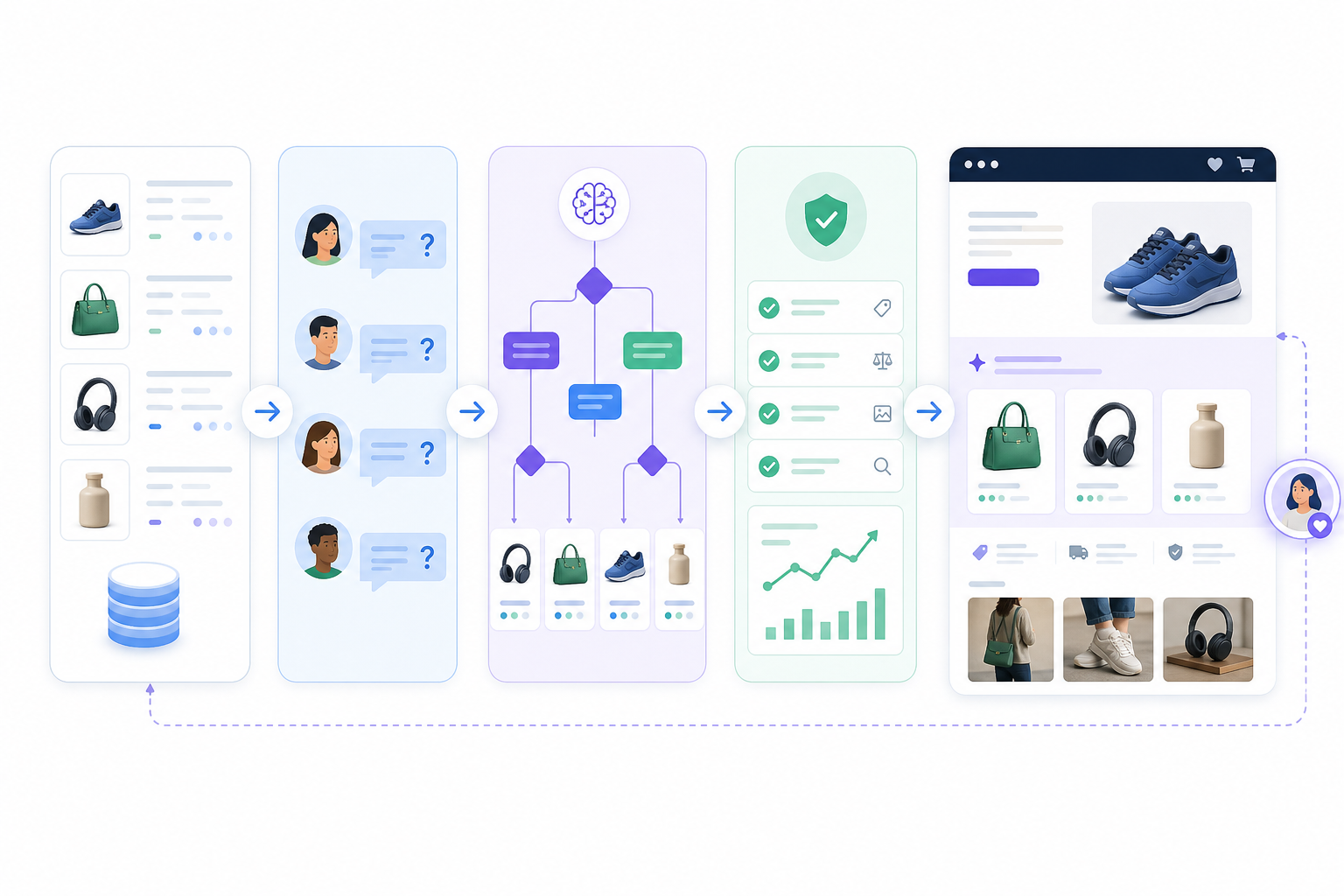
1. Define the conversion event and baseline
Select the action the quiz should influence: completed purchase, product-page visit, add to cart, subscription, consultation booking, or qualified email capture. Record the current baseline for the same traffic source or placement. Without a baseline, a high completion rate can create the illusion of success while revenue remains unchanged.
Useful baselines include conversion rate, average order value, revenue per visitor, return rate, and lead-to-purchase rate. Segment them by device and traffic source because mobile visitors from Meta ads behave differently from returning desktop visitors.
2. Build a product attribute matrix
Create a table with one row per product or variant and one column per meaningful recommendation attribute. Depending on the category, columns might include use case, price band, skin type, flavor, fit, material, compatibility, dietary restriction, experience level, desired outcome, inventory status, and subscription eligibility.
Use standardized values. If one product is tagged “dry skin,” another “for dryness,” and a third “hydrating,” the matching logic will be fragile. Shopify product tags or metafields can supply structured data, but only if the taxonomy is governed consistently.
Separate attributes into three classes:
- Hard constraints: conditions that can disqualify a product, such as an allergy, device incompatibility, vegan requirement, budget ceiling, or unavailable size.
- Weighted preferences: factors that improve a match without disqualifying alternatives, such as scent, texture, color, or intensity.
- Merchandising factors: business inputs such as stock, margin, seasonality, or strategic inventory. These may break a close tie but should not override customer suitability.
3. Draft only decision-changing questions
For every proposed question, ask what changes when the shopper selects each answer. If every response leads to the same product, remove the question or use it only for post-purchase personalization. Most product finders work well with five to eight substantive questions. Complex diagnostic categories may need more, but each extra step should earn its place.
Start with an easy, high-relevance question such as the shopper’s goal or use case. Put sensitive questions later, after the quiz has demonstrated value. Place disqualifying questions before cosmetic preferences so the funnel does not spend time refining products that are fundamentally unsuitable.
4. Create transparent recommendation logic
A simple rule-based score is usually easier to test than opaque AI matching. First apply exclusions. Then award weighted points for compatible attributes. For example, a primary need might add five points, a secondary preference three points, and a minor aesthetic preference one point. Apply an inventory check before presenting the result.
Document the logic in plain language. A merchandiser should be able to explain why Product A beats Product B for a given answer set. Artificial intelligence can assist with question wording, result summaries, and pattern discovery, but core suitability rules should remain auditable—especially in wellness, beauty, financial, or safety-related categories.
5. Design a result page that closes the confidence gap
The result page should not merely reveal a product. It should connect the recommendation to the shopper’s answers. Use a structure such as: “Your best match,” followed by two or three specific reasons, expected use, relevant proof, price, and one clear call to action.
Show one primary recommendation. If useful, provide no more than two alternatives with explicit distinctions such as lower price, richer formula, lighter fit, or greater capacity. Sending shoppers back into a grid of ten “matches” recreates the choice problem the quiz was supposed to solve.
For routines, identify essential and optional items. A three-product core routine with one optional enhancement is more credible than presenting seven products as equally necessary. Where technically appropriate, offer an add-all-to-cart action while still allowing products to be removed.
6. Build the funnel and integrate Shopify
Configure the questions, branching, scoring, results, and tracking in a quiz funnel builder. GeniuzQuiz can be used to create guided quiz funnels and connect lead capture with personalized outcomes; its features page outlines the available workflow, while prebuilt templates can shorten the initial setup.
Confirm that product handles, variants, prices, inventory states, images, and cart actions resolve correctly. Decide what should happen when the top match is unavailable. Good fallback behavior may select the next qualified product, collect a back-in-stock request, or explain that no current product meets a hard constraint. Quietly recommending an unsuitable substitute damages trust.
7. Quality-assure every meaningful path
Create test personas that represent common, high-value, edge-case, and incompatible shoppers. Run each persona through the full experience on mobile and desktop. Verify the result, explanation, variant, price, add-to-cart action, discount behavior, email record, analytics event, and follow-up sequence.
Do not test only ideal combinations. Try contradictory answers, the lowest budget, uncommon sizes, unavailable products, skipped lead forms, browser back buttons, and rapid repeat submissions. Recommendation errors tend to live in these edge cases.
Which questions should a Shopify product quiz ask?
The best questions mirror how customers evaluate the category while using language they already understand. Customer support tickets, on-site search terms, product reviews, sales calls, return reasons, and post-purchase surveys are better sources than internal brainstorming alone.
A practical sequence is:
- Primary goal: What are you trying to achieve?
- Context: Where, when, or how will you use the product?
- Hard constraints: Are there ingredients, formats, sizes, or compatibility requirements to exclude?
- Current state: What are you using now, or what problem do you experience?
- Experience level: Do you want a beginner-friendly, standard, or advanced option?
- Preferences: Which texture, style, flavor, feature, or intensity do you prefer?
- Budget or commitment: What price range, quantity, or purchase frequency is comfortable?
Answer options should be mutually understandable, but they do not always need to be mutually exclusive. If shoppers legitimately have several goals, permit multiple selections and ask them to identify a primary goal when prioritization matters.
Avoid jargon copied from product documentation. “How much support do you prefer?” is easier to answer than a list of proprietary foam technologies. When technical details matter, explain them in a short sentence rather than testing the shopper’s category expertise.
Use optional microcopy for uncertainty. Choices such as “I’m not sure” or “No preference” prevent random answers. Your logic can treat these as neutral rather than forcing false precision.
Lead capture deserves special care. Asking for an email before showing any value usually lowers completion and may attract low-quality addresses if a discount is the only incentive. Test displaying a useful summary first, then offering to save the result, deliver a routine, monitor restocks, or send instructions. If email capture is commercially essential, explain exactly what the shopper receives.
Do not request sensitive health or personal information unless it is genuinely required, lawfully processed, securely stored, and covered by appropriate consent and privacy disclosures. A cosmetic product quiz is not a medical diagnosis. Use cautious language and route serious concerns to qualified professionals where appropriate.
How should quiz results connect to Shopify, email, and ads?

A quiz produces zero-party data: information a customer intentionally provides about goals, preferences, and circumstances. Its value comes from activation, not collection. Before adding a question, decide whether the answer changes the recommendation, result explanation, follow-up message, audience, or customer experience.
At minimum, send the following events to your analytics stack:
- Quiz viewed
- Quiz started
- Question answered, using privacy-safe values
- Quiz completed
- Result viewed
- Recommendation clicked
- Product added to cart
- Lead submitted with consent status
- Purchase completed with order value and matched product
Use a persistent quiz session or result identifier so downstream purchases can be attributed even when the customer moves from the quiz to a product page. Preserve standard Shopify and analytics attribution parameters rather than replacing them with a quiz-only reporting system.
For email and SMS, store a limited set of stable, useful profile properties: primary goal, recommended product or routine, key constraint, preference segment, and completion date. Trigger a short sequence that repeats the recommendation, explains how to use it, answers likely objections, and supplies relevant proof. Avoid sending a generic welcome series that ignores every quiz answer.
For Meta ads, Google Ads, or other paid channels, follow platform policies and consent requirements. Broad, non-sensitive segments may support exclusion, retention, or creative testing. Do not pass prohibited or sensitive attributes. Server-side event delivery can improve measurement resilience, but it does not remove the need for consent, data minimization, and accurate disclosures.
A quiz can also support content strategy, GEO, and AI Overviews indirectly. Aggregated answer patterns reveal the terminology customers use and the comparisons they struggle with. Those patterns can inform product guides, FAQs, support content, and structured explanations that answer real questions. Keep individual customer records separate from anonymized editorial insights.
How do you measure and optimize quiz conversion performance?
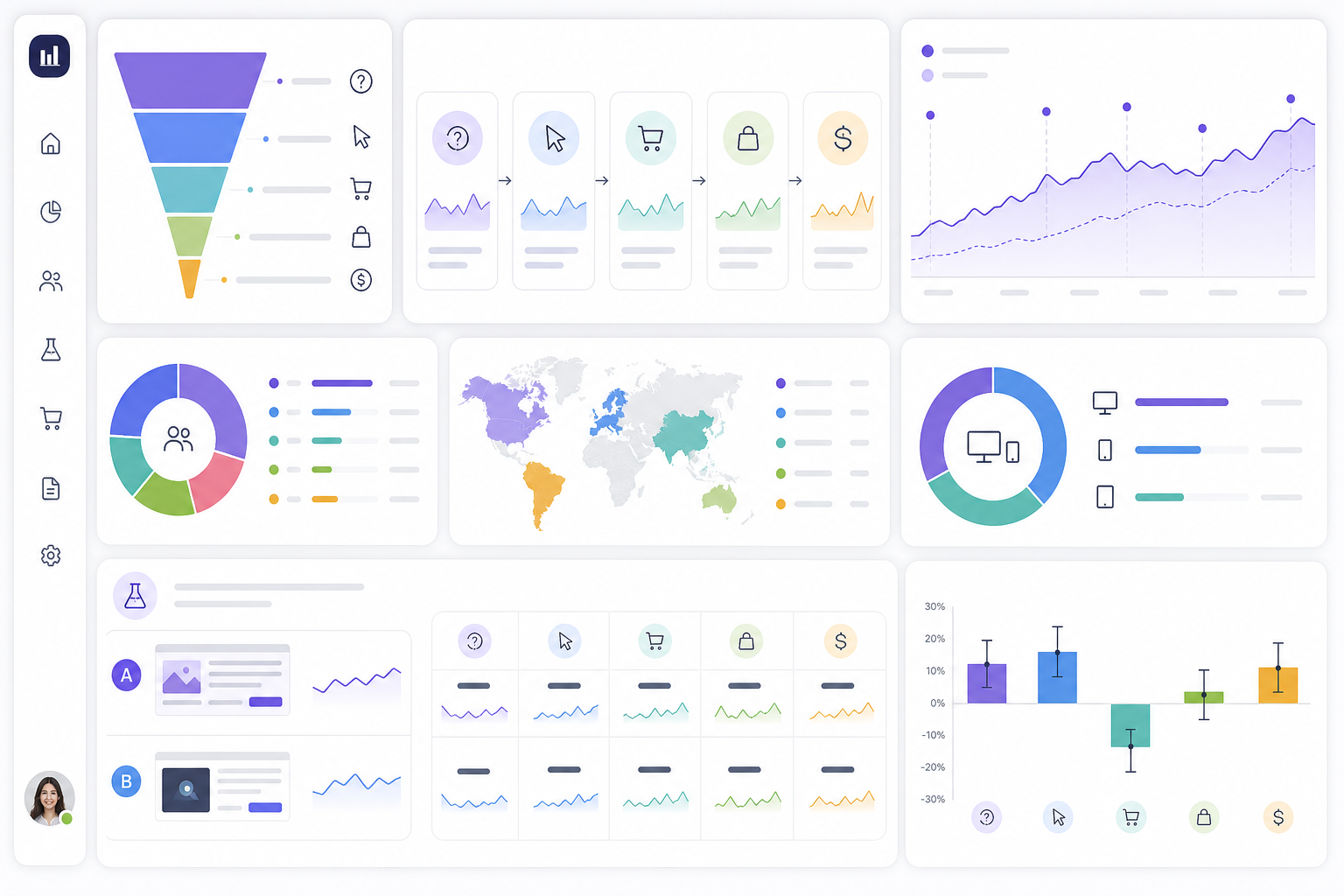
Quiz completion rate is a diagnostic metric, not the final score. A short entertainment-style quiz may achieve excellent completion while producing few sales. The primary metric should connect the experience to commercial value.
Use this measurement hierarchy:
- Revenue per quiz visitor: total attributed revenue divided by unique quiz visitors.
- Quiz-assisted purchase rate: the percentage of quiz visitors who purchase within the chosen attribution window.
- Recommendation click-through rate: result viewers who click a recommended product.
- Result-to-cart rate: result viewers who add a recommended item or bundle to cart.
- Average order value: compare quiz-assisted orders with similar non-quiz orders.
- Return or refund rate: verify that higher conversion does not come from poor matches.
- Qualified lead rate: leads who later engage, purchase, or meet a defined qualification threshold.
Also inspect step-level abandonment. A sharp drop at one question can signal confusing wording, excessive sensitivity, poor mobile design, or answer options that do not represent the shopper. Segment the funnel by source, device, new versus returning visitor, and intended product category.
Run tests against a clear hypothesis. Useful tests include the quiz entry point, opening promise, number of questions, progress indicator, timing of email capture, result-page explanation, number of alternatives, bundle presentation, and call-to-action wording. Avoid changing questions, logic, design, and offer simultaneously because you will not know which change produced the result.
Compare quiz visitors with a credible control group. A raw comparison between people who voluntarily take a quiz and all other visitors is biased because quiz takers may have stronger purchase intent. Better approaches include randomized entry prompts, split landing pages, or matched segments from the same campaign and period.
Set a maintenance schedule. Review results whenever products, prices, variants, inventory, formulations, size charts, or positioning change. Inspect “no match” outcomes and customer service feedback monthly. Revalidate the entire product matrix at least quarterly for an active catalog.
Before publishing, use the MATCH launch check: the Market goal has one measurable outcome; Attributes are standardized; Triage questions change the result; Confidence is built with transparent reasons; and the Hand-off preserves tracking through product, cart, lead, and purchase events. Teams evaluating implementation costs can review GeniuzQuiz pricing after defining these requirements.
Frequently asked questions
How many questions should a Shopify product recommendation quiz have?
Most stores should begin with five to eight decision-changing questions. Use fewer when the catalog is simple and more only when safety, compatibility, sizing, or routine construction genuinely requires additional inputs. Measure abandonment by step and remove questions that neither alter the recommendation nor support a planned follow-up.
Should a product quiz require an email before showing results?
Usually, no. Showing at least part of the result first establishes value and trust. You can then offer to save the recommendation, send instructions, or deliver a personalized routine. If lead generation is the primary objective, test an email gate against an ungated result and compare qualified leads and revenue—not just form submissions.
Can Shopify build a product quiz without an app?
A developer can build one using theme components, Shopify data, custom logic, analytics events, and integrations. That approach offers control but requires ongoing engineering and quality assurance. A quiz funnel platform is generally faster for marketers who need visual editing, branching, lead capture, result pages, and integrations without maintaining custom code.
What is the difference between a product recommendation quiz and a survey?
A survey primarily collects information for analysis. A product recommendation quiz uses answers immediately to guide the participant toward a personalized product, bundle, routine, or next step. One flow can do both, but recommendation quality should not be weakened by research questions that add friction without helping the shopper.
Do product recommendation quizzes improve Shopify conversion rates?
They can improve conversion when product choice is genuinely difficult, the logic produces relevant matches, and the result page explains the recommendation. They can reduce conversion when the catalog is simple, the quiz is too long, or every answer leads to the same bestseller. Validate impact with controlled tests and revenue-based metrics.
Can a Shopify quiz recommend multiple products or a bundle?
Yes. A quiz can produce a routine, kit, subscription, or configurable bundle. Distinguish essential items from optional additions, check inventory at the variant level, and let shoppers edit the bundle. This preserves trust while creating a legitimate opportunity to increase average order value.
How often should product quiz logic be updated?
Update it whenever inventory, products, variants, formulations, prices, compatibility, or merchandising priorities change. For an active store, review edge cases and failed matches monthly and audit the complete attribute matrix quarterly. High-volume stores should automate inventory checks while retaining human review of suitability rules.