Quiz Facebook Ads: Build a Lead-Generation Campaign
Learn how to plan, build, launch, measure, and optimize quiz Facebook ads that turn Meta traffic into qualified leads without wasting budget.
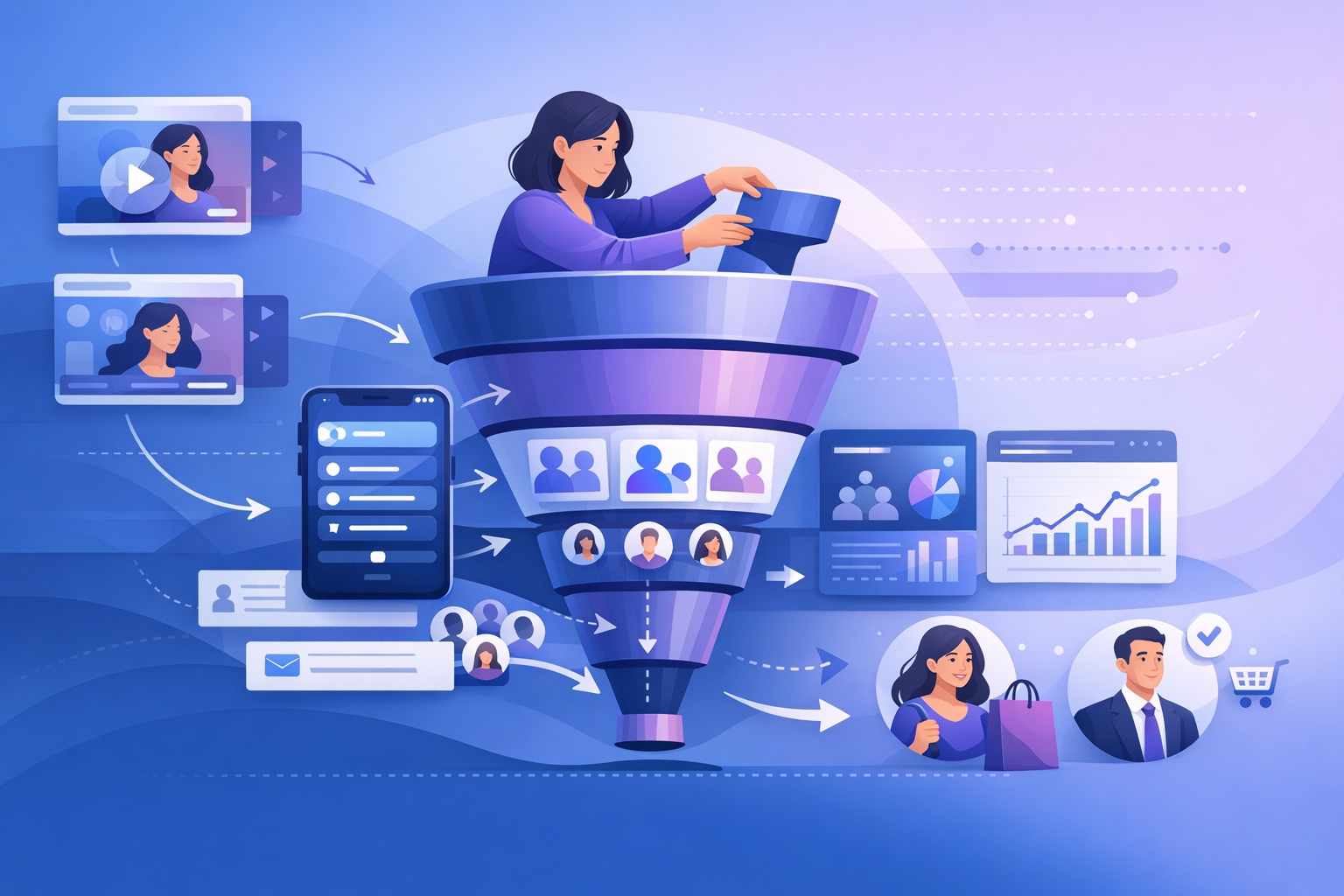
Original illustration by GeniuzQuiz
Quiz Facebook ads send Meta users to an interactive quiz that diagnoses a need, recommends a next step, and captures contact details. To build one, align a narrow audience with a specific quiz promise, advertise the outcome rather than the form, place lead capture after initial value, track qualified leads, and optimize from downstream revenue signals.
Quiz Facebook ads are paid Meta ads that drive people into a quiz funnel instead of directly to a sales page or standard lead form. The quiz acts as both a lead magnet and a segmentation tool: it gives the participant a useful result while collecting information that can personalize follow-up.
Key takeaways
- Sell the quiz result, diagnosis, or recommendation in the ad rather than asking people to “take a quiz.”
- Match one audience problem to one clear promise; broad quizzes usually attract curious but poorly qualified leads.
- Ask easy, relevant questions first and place the email gate after the participant has invested effort.
- Track quiz starts, completions, leads, qualified leads, appointments, and sales rather than judging performance by cost per lead alone.
- Use the MATCH framework: Market, Angle, Transition, Capture, and Handoff.
We use the MATCH framework when planning quiz campaigns: identify the Market, choose the advertising Angle, create a smooth Transition into the quiz, design the Capture step, and build a personalized Handoff to the next offer. A campaign is only as strong as its weakest MATCH component.
How do quiz Facebook ads generate leads?
A conventional Facebook lead ad usually asks for contact information immediately. A quiz campaign earns that information through a short interactive exchange. The person clicks because the promised result is relevant, answers questions about their situation, and receives a recommendation, score, assessment, or personalized plan.
This sequence can improve lead quality because the funnel collects declared data. Instead of knowing only that someone clicked an ad, you may learn their goal, experience level, budget range, timeline, preferred product, or biggest obstacle. Those answers can determine the result page, email sequence, sales assignment, and next call to action.
A quiz funnel does not automatically produce cheaper or better leads. It adds steps, which creates more places for people to leave. The benefit appears when each step increases relevance. If the questions feel arbitrary, the loading experience is slow, or every participant receives the same generic result, a plain landing page may outperform the quiz.
Understand the campaign journey
- Ad impression: A person sees a promise that reflects a recognizable problem or desired outcome.
- Ad click: The landing experience repeats the promise and explains what the participant will receive.
- Quiz start: The first question is easy, non-sensitive, and immediately relevant.
- Quiz progression: Each question helps classify the participant without feeling like an interrogation.
- Lead capture: The funnel explains why an email address or phone number is needed and what happens next.
- Result: The participant receives a specific interpretation, recommendation, or action plan.
- Follow-up: Email, SMS, retargeting, or a sales representative continues the conversation using the quiz answers.
The result is not merely a thank-you page. It is the bridge between curiosity and commercial intent. A strong result identifies what the answers mean, recommends a sensible next action, and gives the participant a reason to take that action now.
Know when a quiz is the right lead magnet
Quiz Facebook ads work especially well when customers need help choosing, diagnosing, estimating, or prioritizing. Examples include a skincare routine finder, financial readiness assessment, fitness plan selector, software maturity score, home renovation estimator, career-path assessment, and agency growth audit.
A quiz is less useful when there is only one obvious product, the purchase is extremely simple, or the questions cannot meaningfully change the recommendation. Do not add interactivity merely because it feels novel. Use it when segmentation improves the customer’s decision or your follow-up.
What offer and quiz should you advertise?
The best quiz topic sits at the intersection of a customer question and a business decision. The customer should want the answer before buying, while your company should be able to use that answer to recommend a product, consultation, plan, or next step.
Start with a narrow promise. “Discover your marketing personality” may generate clicks, but it does not indicate what the participant will do afterward. “Find the Meta ads bottleneck increasing your cost per qualified lead” connects the quiz result to a measurable business problem and a relevant service.
Choose one useful result type
- Assessment: Grades the participant’s current condition, readiness, maturity, or risk.
- Recommendation: Selects a product, service, package, routine, or strategy.
- Calculator: Estimates cost, savings, required capacity, or potential return using stated assumptions.
- Diagnostic: Identifies the most likely bottleneck, obstacle, or source of a problem.
- Profile: Groups people by preferences or behavior. This format needs a clear commercial next step to avoid attracting only entertainment seekers.
We recommend starting with three to five possible results. Two outcomes often feel too generic, while a dozen outcomes create unnecessary copy, logic, and testing work. Each result should have a distinct explanation and action, even if several results eventually recommend the same core product.
Compare common Facebook lead experiences
| Lead experience | Best use | Main advantage | Main tradeoff |
|---|---|---|---|
| Quiz funnel | Diagnosis, recommendation, scoring, or segmentation | Collects declared data and personalizes follow-up | Requires more setup and introduces completion drop-off |
| Meta instant form | Simple offers and fast mobile lead capture | Low friction because fields can be prefilled | Easy submissions can create lower-intent leads |
| Standard landing page | One offer with a short explanation | Simple to build, test, and understand | Provides limited segmentation before capture |
| Direct sales page | Known products with existing demand | Shortest route to purchase | Asks cold audiences to make a larger commitment |
Validate the promise before building
Write five prospective ad hooks and ask whether the quiz result would satisfy each promise. Review sales calls, customer support tickets, search queries, community discussions, and frequently asked questions. Repeated customer language is usually more valuable than brainstorming clever quiz names.
You can also test the concept with a simple ad or organic post before developing full logic. Measure whether the promise attracts relevant comments and landing-page visits. A quiz builder cannot rescue an offer that the target market does not care about.
How do you build a high-converting quiz funnel?
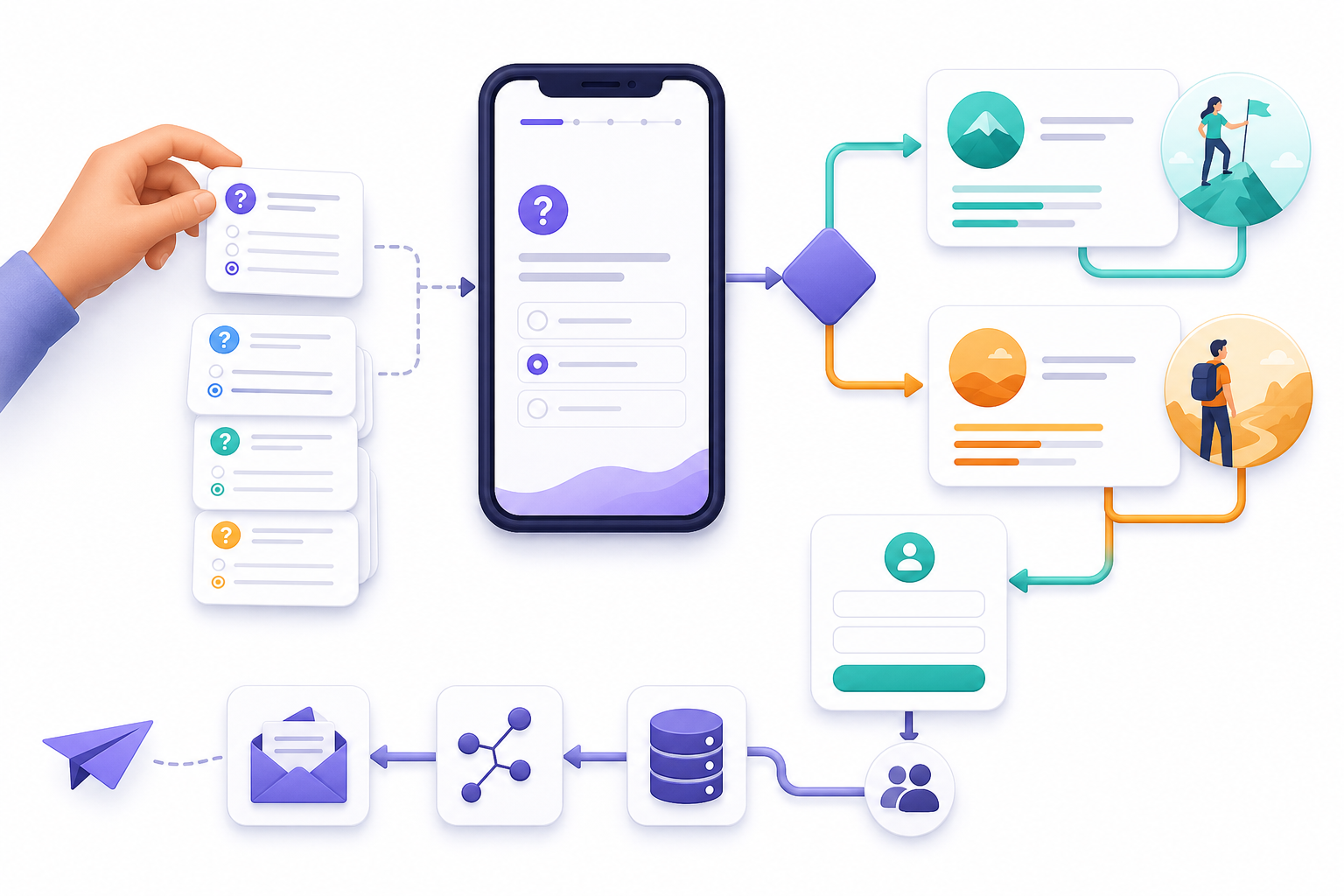
Build the smallest version that can produce a credible result. For most lead-generation campaigns, that means roughly five to nine scored questions, three to five outcomes, one lead-capture step, and one primary call to action. More questions are justified only when they materially improve the recommendation.
Step 1: Map questions to decisions
Every question should affect the result, qualification score, personalization, or sales routing. If removing a question changes nothing, remove it. This rule shortens the quiz and makes your data easier to use.
Begin with low-effort questions such as a primary goal or broad situation. Save questions about budget, purchasing timeline, revenue, or contact details until the participant understands the quiz’s value. Avoid requesting sensitive personal information unless it is genuinely necessary, lawful, and handled with appropriate consent.
Step 2: Write answers for fast mobile scanning
Most Meta ad traffic is mobile. Use concise answer choices that are easy to distinguish. Avoid long grids, overlapping options, jargon, and answers that require participants to perform calculations. Include “not sure” when uncertainty is realistic; forcing a false choice damages the recommendation.
Progress indicators can reduce uncertainty, but they must be accurate. If the page says a quiz takes two minutes, it should not expand into multiple hidden sections. Test it with people who did not help write it because authors tend to underestimate reading time.
Step 3: Create transparent scoring and branching
Simple scoring is easier to audit than an opaque algorithm. Assign points to outcomes or qualification criteria, document tie-breaking rules, and test contradictory answer combinations. Branch only when it removes irrelevant questions or changes the participant’s path in a meaningful way.
For example, a software assessment might score team size, process maturity, urgency, and integration needs. The public result could identify the operational bottleneck, while an internal qualification score determines whether the lead enters self-serve nurturing or receives outreach from sales.
Step 4: Place the lead gate at the value threshold
Asking for an email before the first question maximizes data requests but gives the participant no reason to comply. Asking after displaying the complete result can reduce opt-ins because the value has already been delivered. A practical starting point is to place the gate after the final answer but before the detailed result.
Explain the exchange precisely: “Enter your email to see your score, three recommended actions, and a copy of your results.” Do not imply that a result is free and then unexpectedly require a sales call. Trust gained during the quiz influences whether the lead opens subsequent messages.
Step 5: Make every result genuinely different
A useful result page includes the result name, a plain-language explanation, evidence from the participant’s answers, two or three recommended actions, and one next step. Referencing answers proves that the output is personalized. For instance, “Because your priority is speed and your team has no dedicated analyst, begin with the automated reporting workflow” is stronger than “You need better reporting.”
GeniuzQuiz can be used to build the quiz logic, lead capture, and personalized outcomes. Review its features when mapping technical requirements, or adapt one of the available templates rather than starting with a blank funnel.
Step 6: Connect the handoff
Send the lead and useful answer data to your email platform or customer relationship management system. Use consistent field names, keep the original result, and record consent context. Trigger different follow-up sequences where the difference is meaningful, not merely because personalization is technically possible.
A high-intent lead might see an appointment calendar and receive a short sales follow-up. A lower-intent participant might receive educational material tied to the result. Product recommendation leads should see the selected product, why it fits, and alternatives when appropriate.
How should you set up Meta ads for a quiz campaign?
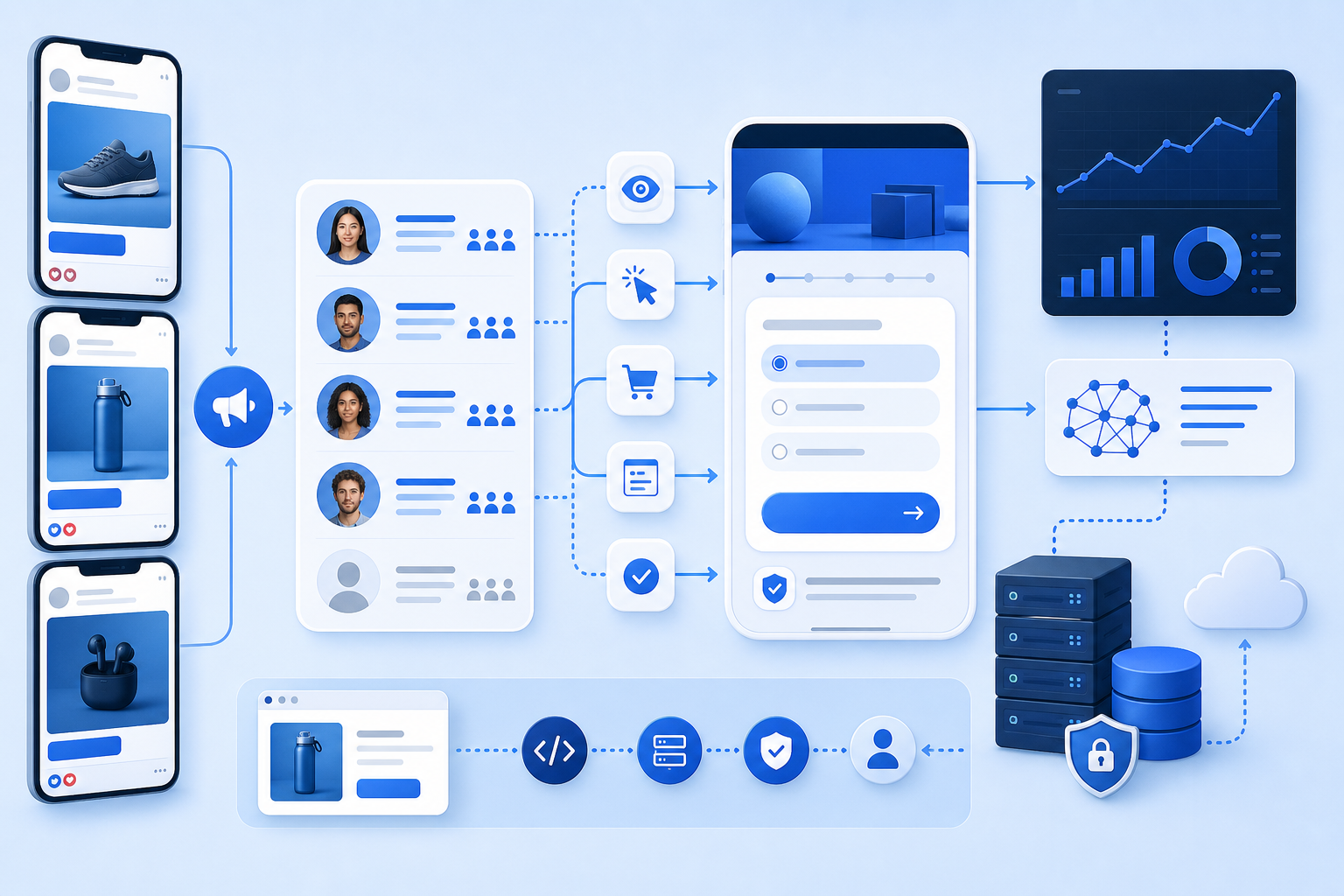
Configure tracking and quality feedback before increasing spend. Meta can optimize only from the events it receives, and the cheapest event is not necessarily the most valuable one. If your campaign reports every quiz start as a lead, the delivery system may find enthusiastic starters who never submit contact information.
Choose the campaign objective and conversion event
Use an objective aligned with the actual action you want, subject to the options available in your Meta Ads Manager account. A website conversion setup is often appropriate when the quiz lives on your site and you can send browser and server events. Meta instant experiences may reduce loading friction, but they can restrict the design and data flow you need.
Define separate events for landing-page view, quiz start, meaningful progress, quiz completion, lead submission, qualified lead, appointment, and purchase where possible. Optimize initially for an event with enough volume to help delivery learn, but move toward a deeper event when reliable volume and attribution are available.
Install measurement correctly
- Install the Meta Pixel on the quiz and result pages.
- Use Conversions API when feasible to supplement browser-side event delivery.
- Deduplicate matching browser and server events so one action is not counted twice.
- Pass event IDs, timestamps, value data, and source URLs consistently.
- Add UTM parameters for campaign, ad set, ad, and creative analysis outside Meta.
- Test the full journey on mobile, including consent, validation errors, result loading, and CRM delivery.
Follow applicable privacy, consent, and advertising rules. Meta restricts targeting and creative practices involving personal attributes, and additional limitations apply to special ad categories such as housing, employment, and credit. A quiz should not imply that you know a user’s medical condition, finances, religion, or other sensitive trait from their Facebook activity.
Structure audiences for interpretable tests
Begin with a limited number of ad sets. One broad or algorithmically expanded audience and one clearly defined interest or first-party audience can provide more useful learning than ten fragmented audiences with tiny budgets. Exclude existing customers when the acquisition offer is not relevant to them.
Retarget people based on meaningful funnel behavior. Someone who clicked but did not start may need stronger message continuity or a faster page. Someone who completed the questions but did not submit contact details may need better value explanation. Existing leads should see the next offer rather than the same quiz repeatedly.
Write ads that sell the outcome
Strong quiz ad creative usually contains four elements: a recognizable problem, a specific output, a low-friction expectation, and a credible reason to trust the result. For example: “Not sure why your lead costs keep rising? Answer seven questions to identify whether your primary bottleneck is targeting, creative, conversion, or follow-up. Get a practical action plan in about two minutes.”
Test meaningful angles rather than changing punctuation. One creative might lead with a painful symptom, another with the desired outcome, and another with a common mistake. Keep the quiz promise consistent after the click. An ad about lowering acquisition costs should not land on a broad “What type of entrepreneur are you?” assessment.
Set a learning budget you can evaluate
Base the budget on the number of leads required to judge quality, not on an arbitrary daily amount. If only one in five leads reaches your qualification threshold, evaluating five total leads says very little. Estimate expected click cost, landing-page-to-lead rate, and qualified-lead rate, then calculate the likely spend needed for a useful sample.
Do not make daily edits in response to ordinary variance. Set review intervals, document changes, and avoid altering audience, creative, quiz, and follow-up simultaneously. Controlled iteration helps you identify why results changed.
Which quiz ad metrics should you track?
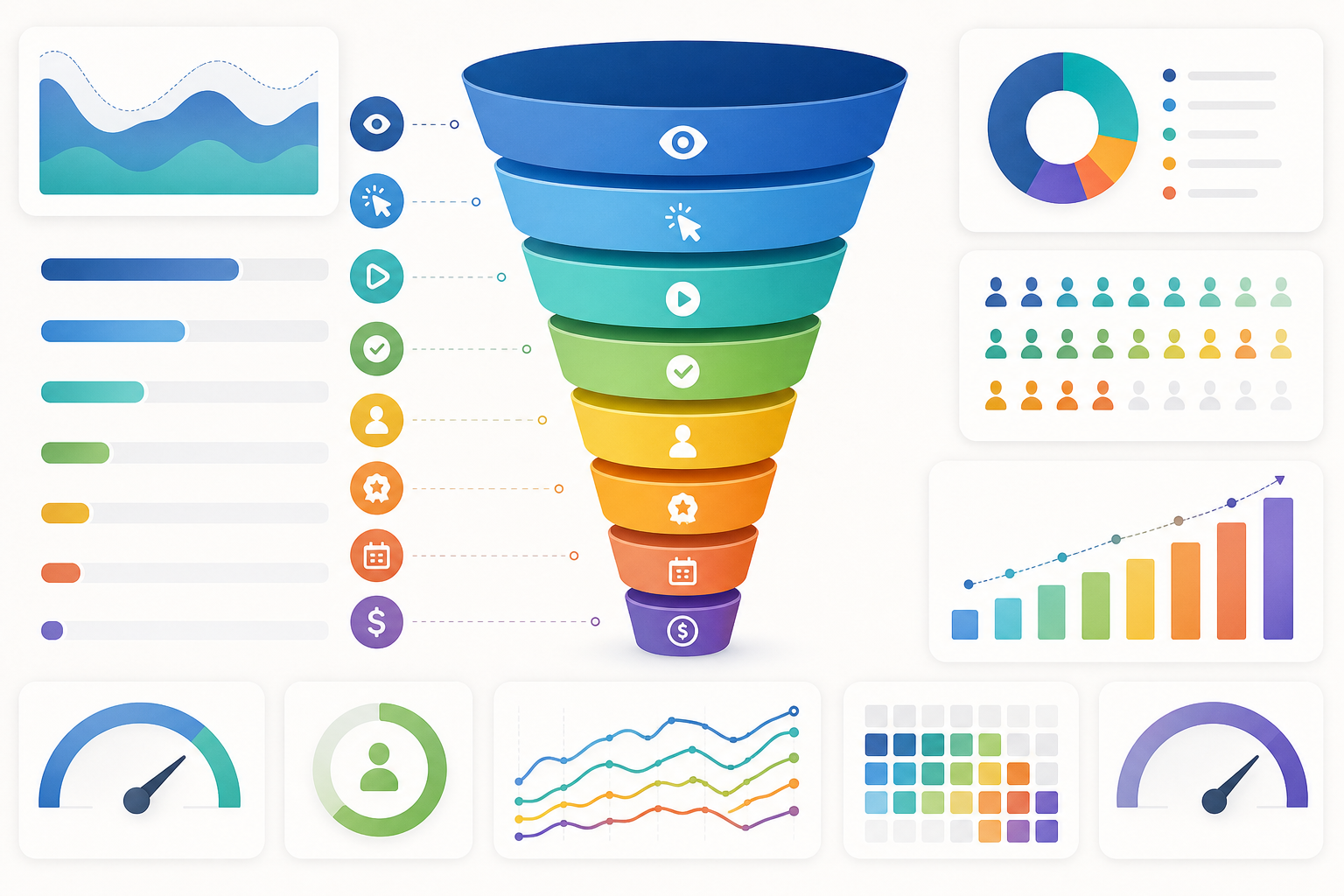
A quiz campaign is a sequence, so a single blended conversion rate hides where performance breaks. Measure each transition and connect it to business outcomes. The most important metric is usually cost per qualified lead or customer acquisition cost, not raw quiz completion rate.
| Metric | Calculation | What it diagnoses |
|---|---|---|
| Outbound click-through rate | Outbound clicks divided by impressions | Whether the creative and promise earn attention |
| Landing-page view rate | Landing-page views divided by outbound clicks | Page speed, tracking gaps, or accidental clicks |
| Quiz start rate | Quiz starts divided by landing-page views | Message match and opening-page clarity |
| Quiz completion rate | Completed quizzes divided by quiz starts | Question relevance, length, usability, and trust |
| Lead capture rate | Lead submissions divided by completed quizzes | Strength of the result promise and form friction |
| Qualified-lead rate | Qualified leads divided by total leads | Audience and quiz qualification quality |
| Cost per qualified lead | Ad spend divided by qualified leads | Acquisition efficiency after lead quality |
| Lead-to-sale rate | New customers divided by leads | Offer fit, follow-up, sales process, and lead intent |
Use benchmarks as warning signals, not universal targets. A five-question consumer product finder and a detailed business assessment should not have the same completion rate. Your baseline should be segmented by device, placement, audience, creative, quiz result, and traffic temperature.
Read funnel patterns instead of isolated numbers
- High click-through rate and low start rate: The ad may overpromise, the landing page may load slowly, or the first screen may not match the creative.
- Strong start rate and low completion rate: The quiz may be too long, repetitive, confusing, or intrusive.
- Strong completion and weak lead capture: The result may not seem valuable enough to exchange for contact details.
- Cheap leads and poor qualification: The angle may attract curiosity rather than buying intent, or the qualification rules may be too loose.
- Qualified leads and weak sales: Investigate response time, offer alignment, pricing, calendar friction, and sales execution before blaming the ads.
Send downstream quality back to advertising
Record which leads become qualified opportunities, booked appointments, purchases, and repeat customers. When technically and legally appropriate, return deeper conversion events to Meta so optimization is informed by value rather than form submissions alone. Maintain a separate source of truth in your analytics or CRM because platform attribution is directional, not a complete financial record.
Quiz-answer patterns can also inform landing pages, sales enablement, customer education, and organic content. Repeated questions may become useful FAQ material for search, AI Overviews, and GEO, but aggregate and anonymize insights rather than exposing personal responses.
How do you optimize quiz Facebook ads without hurting lead quality?
Optimize the largest verified constraint first. Changing the button color will not repair a misleading ad, and rewriting the result will not fix a page that rarely loads. Rank problems by the amount of qualified-lead loss they create, then test one major variable at a time.
Use the MATCH optimization checklist
- Market: Are the people reached capable of benefiting from and buying the next offer?
- Angle: Does the ad promise a specific result that attracts the right intent?
- Transition: Does the page quickly confirm the promise and make starting easy?
- Capture: Is the requested information proportional to the value offered?
- Handoff: Does the result produce a relevant next step and prompt follow-up?
This order prevents a common mistake: maximizing quiz completion while ignoring whether the participants resemble good customers. More leads are not an improvement if qualification and revenue fall faster than cost per lead.
Prioritize high-impact tests
- Test a diagnostic promise against a recommendation promise.
- Compare problem-led, outcome-led, and evidence-led creative angles.
- Remove one low-value question and measure completion plus qualification.
- Test lead capture before the result preview versus after a short result teaser.
- Compare one general follow-up sequence with result-specific sequences.
- Test a consultation call to action against a lower-commitment personalized report.
Define the primary metric and a quality guardrail before each test. For example, the primary metric might be cost per lead, while the guardrail is a qualified-lead rate that must not fall below an acceptable level. This keeps a superficially cheap variant from winning at the expense of sales.
Improve speed and accessibility
Compress scripts, limit unnecessary tracking tools, and test on slower mobile connections. Keep answer controls large enough to tap, ensure adequate contrast, use plain language, and display clear errors. A participant who loses answers after an interruption is unlikely to restart.
Review preview cards, browser behavior, and every major Meta placement. Vertical creative may need different composition from feed creative even when the message is identical. Avoid embedding essential instructions only inside an image or video because some users will not see or hear them.
Scale with stable economics
Scale only after confirming that leads reach the CRM, receive timely follow-up, and convert at a sustainable rate. Increase budgets gradually, introduce additional creative, and expand audiences while monitoring cost per qualified lead and customer acquisition cost. Rapid budget increases can change delivery patterns, so compare cohorts rather than assuming performance will remain linear.
Before choosing software, estimate traffic, integrations, result logic, and the number of active funnels you need. GeniuzQuiz publishes its available pricing so the platform cost can be included in campaign economics rather than treated as an afterthought.
Frequently asked questions
Do Facebook quiz ads work for lead generation?
Yes, when the quiz helps users make a decision and helps the advertiser segment or qualify them. They tend to work best for products and services involving diagnosis, recommendation, estimation, or multiple customer needs. A generic personality quiz may produce inexpensive leads without producing customers.
How many questions should a Facebook lead quiz have?
Five to nine scored questions is a practical starting range. Use fewer when the recommendation is simple and more only when each additional answer improves the result or qualification. Test completion by question to identify the precise point where participants leave.
Should I ask for an email before or after the quiz?
For cold Meta traffic, start by asking after the final question and before the detailed result. At that point the participant has invested effort but still expects value. Test a short result preview before the form if capture is weak, and always explain what will be emailed.
What is a good conversion rate for quiz Facebook ads?
There is no universal rate because quiz length, industry, traffic temperature, placement, and lead definition vary. Establish separate baselines for click-to-start, start-to-completion, completion-to-lead, and lead-to-qualified-lead. A lower raw conversion rate may be preferable if it creates a substantially higher proportion of qualified buyers.
Should I use a Meta instant form or send traffic to my quiz?
Use an instant form when speed and simple data capture matter most. Send traffic to a quiz when answers need to influence recommendations, qualification, or follow-up. You can test both, but compare qualified-lead cost and sales rather than platform-reported lead cost.
How much should I spend testing a quiz campaign?
Work backward from the number of qualified leads needed for a decision. Estimate click cost, lead conversion rate, and qualified-lead rate, then fund enough traffic to observe multiple outcomes. A tiny test may identify technical problems, but it usually cannot establish stable acquisition economics.
Are Facebook quiz ads allowed under Meta advertising policies?
Quiz ads are generally permitted, but the ad, questions, targeting, landing page, and data handling must follow Meta policies and applicable law. Avoid asserting or implying sensitive personal attributes. Use appropriate disclosures and consent, and check special ad category restrictions for housing, employment, credit, social issues, elections, or politics.
How quickly should quiz leads receive follow-up?
Deliver the promised result immediately. For high-intent consultation or sales leads, fast human follow-up is usually preferable while the assessment is still fresh. Use quiz answers in the message, but do not repeat sensitive information unnecessarily or make the recipient feel surveilled.