Quiz Funnel Builder: Best Software for Leads in 2026
Compare the best quiz funnel builder software for lead generation, segmentation, and product recommendations, with selection criteria and setup steps.

Original illustration by GeniuzQuiz
What is a quiz funnel builder?
A quiz funnel builder is software that asks prospects branching questions, scores or segments their answers, captures contact data, and routes each person to a relevant product or sales path. The best choice depends on the job: lead generation, ecommerce recommendations, assessments, or complex calculators—not the longest feature list.
Our MATCH-6 framework evaluates a quiz funnel through six operational layers: Motive, Attribution, Taxonomy, Conditional logic, Handoff, and Experimentation. A builder is only a good fit when it supports all six layers required by the funnel, from the visitor's initial reason for participating to the downstream conversion event.
Key takeaways
- Choose software around the funnel's primary job: email acquisition, qualification, assessment, or product recommendation.
- Branching logic matters less than whether answers become usable segments in your CRM, email platform, or ecommerce stack.
- For paid acquisition, preserve Meta ads and Google Ads attribution data through the quiz, opt-in, result, and purchase events.
- A useful result must deliver immediate value; a generic score followed by an aggressive sales pitch usually reduces trust.
- Measure result-page action rate, qualified lead rate, and revenue per quiz start—not completion rate alone.
Unlike a conventional lead magnet, a quiz collects declared preference data while delivering a personalized outcome. A downloadable checklist may reveal that someone wants information, but a well-structured quiz can reveal the person's goal, constraints, urgency, budget range, product fit, and readiness to buy.
The category includes several related products. Form builders primarily collect data. Survey tools emphasize research. Assessment platforms calculate scores or benchmarks. Product recommendation engines map answers to catalog items. A true quiz funnel builder connects those functions to marketing automation, segmentation, conversion tracking, and a next-step offer.
That distinction is important when evaluating demos. Almost every modern form tool can display one question at a time. Fewer can maintain hidden attribution fields, apply weighted scoring, branch around irrelevant questions, send structured properties to a CRM, display dynamic recommendations, and support reliable conversion experiments without custom code.
Which quiz funnel builder is best for lead generation?
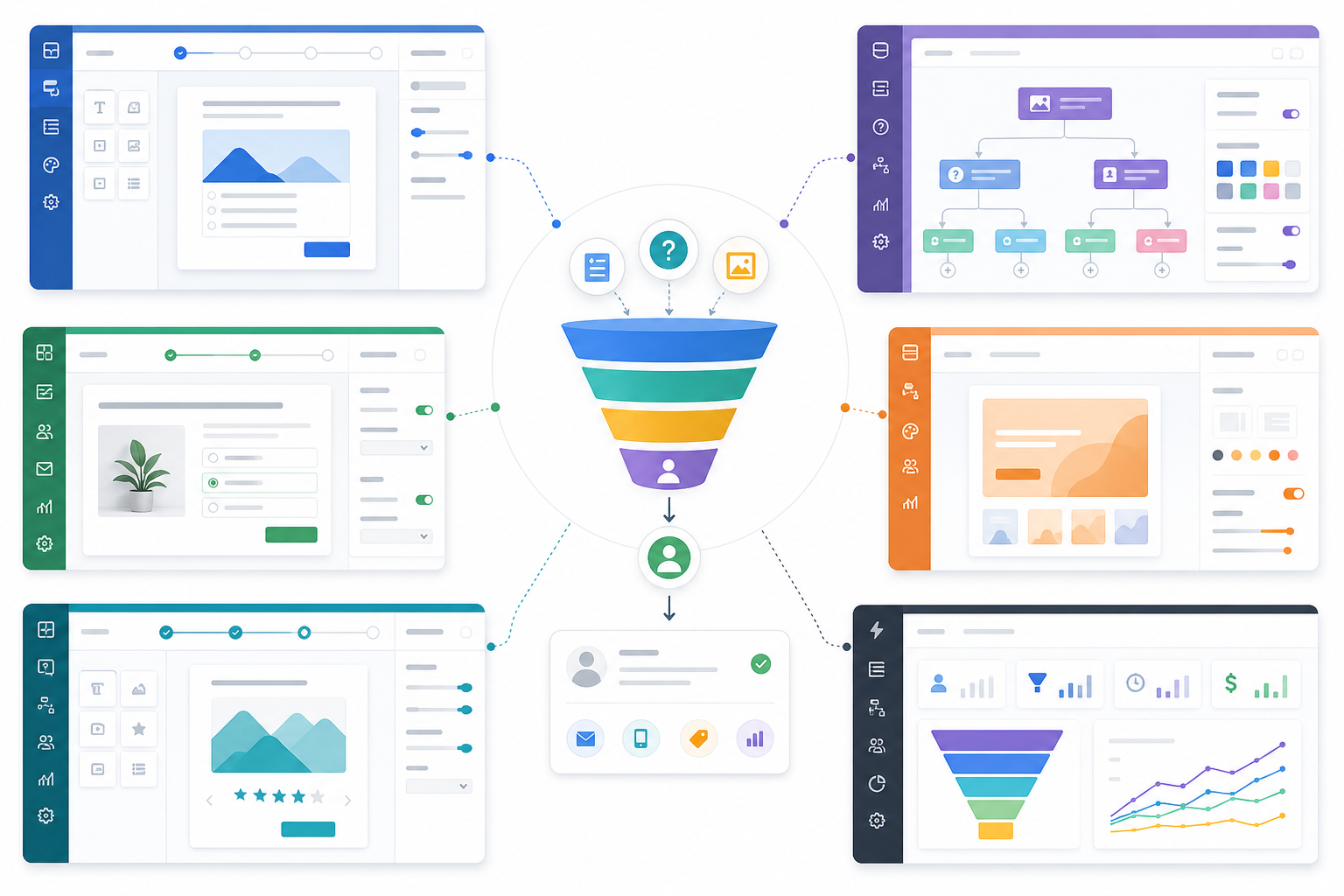
There is no universal winner. The best quiz funnel builder is the one that fits the funnel's decision model and destination system. A direct-to-consumer skincare brand needs catalog-aware recommendations and variant handling. A consultant may need weighted qualification, calendar routing, and CRM ownership rules. A publisher may prioritize fast template deployment and email list growth.
| Software | Best fit | Notable strength | Primary tradeoff |
|---|---|---|---|
| GeniuzQuiz | AI-assisted lead generation and recommendation funnels | Combines quiz creation, segmentation, and personalized funnel outcomes | Teams should still define their offer logic before relying on AI-generated questions |
| Typeform | Polished forms, surveys, and simple lead quizzes | Strong conversational interface and broad integration ecosystem | Advanced recommendation logic may require integrations or external automation |
| Interact | Marketing quizzes for creators and small businesses | Large template-led workflow for personality and list-building quizzes | Less suitable for calculation-heavy or catalog-intensive experiences |
| Outgrow | Calculators, assessments, and interactive content | Supports multiple interactive formats and numerical outcomes | Broader capabilities can increase configuration and governance work |
| involve.me | Multi-step forms, calculators, surveys, and funnels | Flexible content types within one visual workflow | Teams need disciplined naming and analytics conventions as projects multiply |
| ScoreApp | Scorecards for coaches, consultants, and B2B qualification | Assessment-led reports and category scoring | Less focused on ecommerce catalog recommendations |
| Octane AI | Shopify product recommendation quizzes | Ecommerce-oriented personalization and customer data use | Most compelling when Shopify is central to the commerce stack |
The comparison should be treated as a use-case map rather than a fixed league table. Product capabilities, plans, limits, and integrations change. Before purchasing, test the exact workflow with a representative quiz, your actual destination platform, and enough answer combinations to expose routing failures.
Best for a balanced lead-generation workflow
Choose a dedicated quiz funnel platform when the quiz is expected to perform more than data collection. For example, GeniuzQuiz is designed to build quiz funnels that segment participants and move them toward relevant recommendations or offers. Teams can review its features against the MATCH-6 requirements rather than comparing interface screenshots alone.
The balanced option is usually preferable when marketers need to launch without repeatedly involving engineering, but still need structured outcomes. Look for editable result logic, native lead capture, reusable variables, integrations, conversion events, and a clear way to test every result path.
Best for elegant forms and lightweight quizzes
Typeform is a sensible candidate when visual presentation, surveys, and general-purpose data collection are the priority. It is familiar to many marketing and research teams, which can reduce training time. The tradeoff appears when a funnel needs complex scoring, multiple product mappings, inventory-aware recommendations, or extensive result-page personalization.
Best for template-led audience growth
Interact is commonly evaluated by creators, coaches, and service businesses launching personality-style lead magnets. Templates can accelerate the first draft, especially when the intended result is an email segment. The critical review is whether the template's categories genuinely predict a useful next action or merely attach entertaining labels to participants.
Best for calculators and assessments
Outgrow and involve.me are strong candidates when the interactive asset extends beyond a conventional quiz. A return-on-investment calculator, maturity assessment, price estimator, or savings model often needs formulas, ranges, and conditional outputs. Confirm how each platform handles formula validation, rounding, missing inputs, report generation, and analytics before committing.
Best for scorecards and B2B diagnostics
ScoreApp is oriented toward assessments that rate a respondent across categories. This model works for readiness audits, operational benchmarks, and consulting diagnostics. It is less about selecting one product from a catalog and more about exposing gaps that can support a consultation, report, or nurture sequence.
Best for Shopify product recommendations
Octane AI deserves consideration when the central job is recommending Shopify products from shopper answers. Ecommerce teams should verify variant support, product availability behavior, add-to-cart tracking, customer profile synchronization, and what happens when a recommended item is unavailable. A visually impressive recommendation is not useful if it creates merchandising conflicts.
How should you compare quiz funnel software?
Start with a written decision model, not a vendor demo. Vendors naturally highlight visible features such as themes, animations, and AI generation. The higher-risk requirements are usually hidden: data portability, attribution continuity, answer-to-segment mapping, event reliability, consent records, and maintainability after the original builder leaves the team.
Step 1: Define the motive
State why a visitor would start the quiz and why the business is building it. The participant's motive could be choosing the right running shoe, diagnosing a growth bottleneck, or estimating implementation cost. The business motive could be list growth, qualified demo requests, first-party data collection, or average order value.
These motives must overlap. If the participant expects an impartial diagnosis but receives a result that recommends the same product regardless of answers, the experience breaks its value exchange. Write one sentence for the participant promise and one for the commercial goal before creating questions.
Step 2: Protect attribution
Specify the acquisition fields and events that must survive the journey. Common fields include source, medium, campaign, ad set, creative, landing page, referring URL, and first-touch timestamp. For Meta ads, distinguish a quiz-start event from lead submission and purchase. Sending every event as a lead can distort optimization and reporting.
Test attribution across browsers, mobile devices, embedded quizzes, redirects, consent states, and return visits. If hidden fields disappear after the result-page redirect, campaign-level revenue analysis becomes unreliable even though the quiz appears to work.
Step 3: Design the taxonomy
Taxonomy means the controlled set of answer labels, segments, scores, and recommendation IDs used by downstream systems. Prefer stable values such as goal_retention or fit_enterprise over full answer sentences. Display copy can change without breaking CRM workflows when the underlying property values remain stable.
Document whether a field is single-select, multi-select, numeric, Boolean, or free text. Also identify its system of record. Duplicate fields such as company size, lifecycle stage, and primary goal can diverge when the quiz platform, CRM, and email tool all attempt to overwrite one another.
Step 4: Map conditional logic
Create a routing matrix outside the builder. Rows can represent important answer combinations, while columns show skipped questions, assigned segments, recommended products, lead owners, and next actions. Test boundary conditions, ties, contradictory answers, and the default route for an unexpected combination.
Do not add branches merely because the software allows them. Branching should remove irrelevant questions or materially change the outcome. Excessive branching makes quality assurance harder and produces segments too small to analyze.
Step 5: Verify the handoff
The handoff is the transition from quiz result to email sequence, product page, calendar, CRM queue, or sales conversation. Confirm field mappings, deduplication behavior, update rules, error retries, and the delay between submission and action. A lead that receives the wrong nurture sequence is worse than a lead stored without segmentation because the error is visible to the prospect.
Step 6: Plan experimentation
Determine which elements can be changed without invalidating the measurement model. Useful experiments include landing-page promise, first question, question order, opt-in position, result explanation, recommendation presentation, and call to action. Avoid changing traffic source, scoring rules, and result-page offer simultaneously; the winning cause will be impossible to identify.
What features matter in a product recommendation quiz?
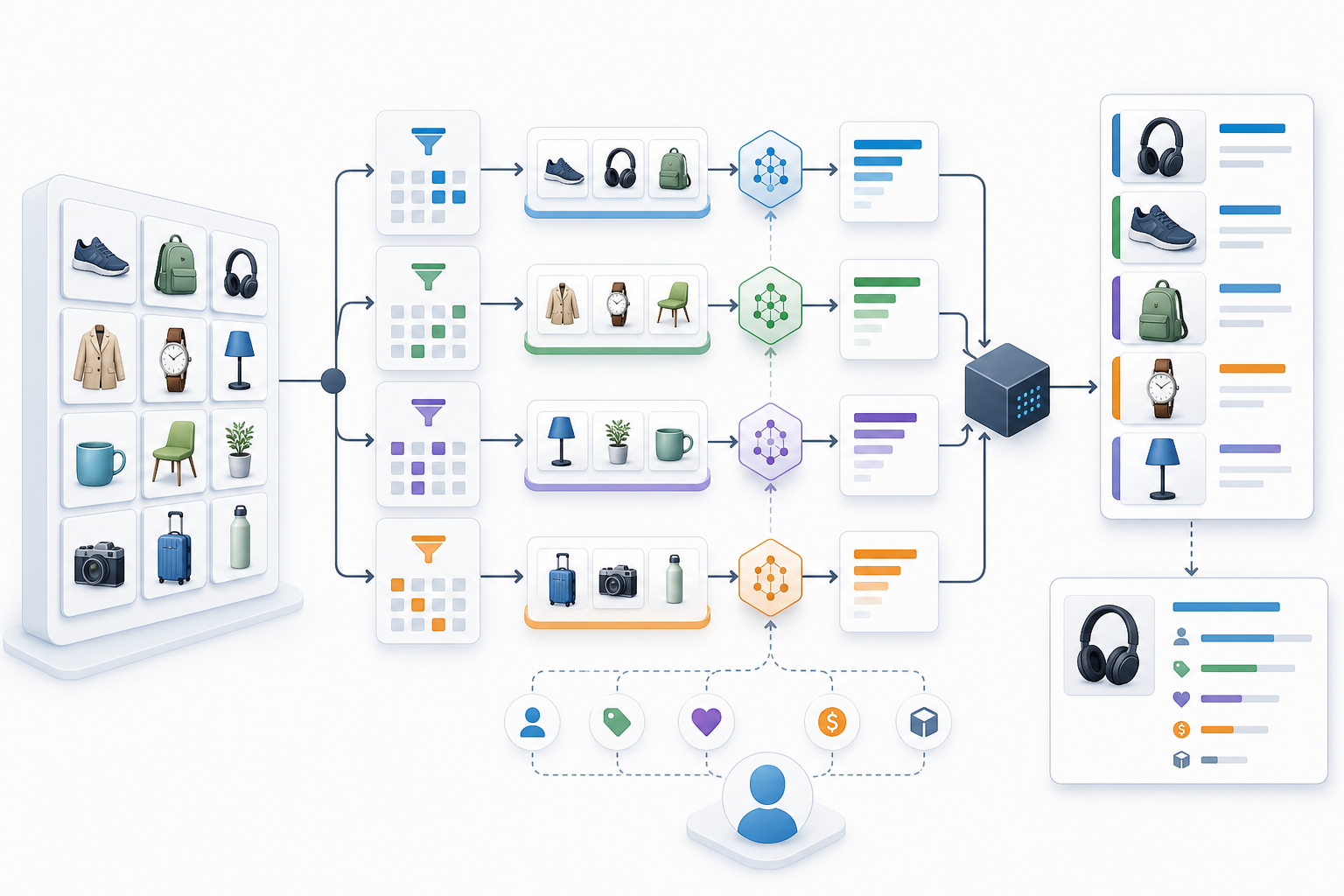
A product recommendation quiz is a constrained decision engine. Its quality depends on accurate product eligibility rules, meaningful preference questions, transparent recommendation reasons, and a low-friction path to purchase. Generative AI can draft questions and copy, but it should not invent product attributes or silently decide safety-critical suitability.
Eligibility rules before preference scoring
Separate hard constraints from soft preferences. A hard constraint excludes an option: incompatible device, allergen, service region, required integration, size availability, or budget ceiling. A soft preference ranks eligible options: color, style, desired speed, feature priority, or brand affinity.
Apply exclusions first and scoring second. If a quiz simply adds points, a strongly preferred but incompatible product may still win. Store a fallback route for cases where no item satisfies every hard constraint. That fallback might recommend a category, request human review, or explain which requirement caused the conflict.
Weighted scoring and tie resolution
Weighted scoring is useful when some answers are more predictive than others. For each product or outcome, assign answer weights based on known fit rather than intuition alone. Historical purchases, returns, consultations, support tickets, and customer interviews can inform the initial weighting.
Define tie resolution explicitly. Options include prioritizing availability, margin, popularity, lower implementation complexity, or the answer to a designated tie-breaker question. The commercial rule should never override a hard suitability constraint. Log both the winning result and the runner-up so analysts can identify unstable recommendations.
Explainable results
A recommendation should state why it fits. Refer to two or three relevant answers, summarize the main benefit, acknowledge an important limitation, and offer a comparison or alternative where appropriate. Explainability increases confidence and gives the participant evidence that the result was actually personalized.
For example, a software quiz might recommend a plan because the respondent needs five user seats, advanced reporting, and CRM synchronization. It could also explain that a lower plan is sufficient if CRM synchronization is not required. This is more credible than presenting one package as the inevitable answer.
Catalog and lifecycle controls
Ecommerce teams need rules for discontinued products, inventory changes, variants, bundles, regional availability, sale periods, and new releases. Decide whether recommendations update dynamically from the catalog or require manual publication. Also define what an existing customer sees when they already own the primary recommendation.
Service businesses have an equivalent lifecycle problem. Offers, territories, sales capacity, qualification thresholds, and calendar availability change. The quiz logic needs an owner and review schedule; otherwise, a once-accurate funnel gradually becomes a source of bad routing.
AI generation with human governance
AI can accelerate question ideation, result copy, answer normalization, and test-case generation. Human review remains necessary for claims, scoring validity, product data, regulated categories, and brand positioning. Keep a versioned logic document outside the platform so the team can explain how each result is produced.
Templates are useful for structure, but they are not evidence that a particular question predicts purchase. Teams can begin with curated templates, then replace generic questions with language collected from customer interviews, sales calls, search queries, and support conversations.
How do you build a quiz funnel that converts?
A high-converting quiz aligns traffic intent, question value, opt-in timing, result usefulness, and the next offer. Conversion is not achieved by making every quiz shorter. It comes from removing questions that do not improve personalization, qualification, trust, or routing.
Start with one audience and one decision
Choose a narrow audience and a decision they already want to make. “Find your best project management setup” is more actionable than “What kind of entrepreneur are you?” when the commercial objective is software recommendations. The landing page should identify who the quiz is for, the outcome, the expected effort, and how the answers will be used.
Ask high-information questions first
The first question should be easy to answer and clearly connected to the promised result. Goal, use case, or current situation often works better than contact information. Avoid opening with sensitive questions, internal jargon, or a long multi-select list.
Evaluate every question by information gain: does the answer exclude an option, change the score, create a useful segment, alter the explanation, or support a follow-up? If it does none of these, remove it. Questions included solely because the data might be useful later increase abandonment and privacy exposure.
Use branching to reduce irrelevant work
Skip technical implementation questions for respondents who selected a fully managed service. Hide household questions from business buyers. Ask a clarifying question only when an earlier answer creates ambiguity. This approach makes the experience feel personalized before the final result appears.
Place the opt-in around perceived value
Pre-result opt-ins often capture more leads because the result is gated, but they can generate lower-intent addresses and frustration. Post-result opt-ins provide value first but may collect fewer contacts. A hybrid model shows a concise result immediately and requests an email for a detailed plan, comparison, saved result, or tailored sequence.
The opt-in copy should say what will be sent, how often, and whether the participant is subscribing to marketing. Record consent separately from the operational act of sending a requested result. Privacy requirements vary by jurisdiction, so legal review should cover consent language, retention, profiling, and deletion workflows.
Build a result page, not a result label
A strong result page includes the outcome, a plain-language explanation, evidence from the participant's answers, recommended action, alternative option, and one primary call to action. It can also answer likely objections or show a short implementation plan.
Match the call to action to readiness. A low-intent participant may need a guide or comparison. A qualified B2B buyer may be ready for a consultation. A shopper with a clear fit may need an add-to-cart action. Sending every segment directly to a sales calendar usually wastes both visitor attention and sales capacity.
Connect follow-up to the result
Repeat the result and recommendation in the first email so the handoff feels continuous. Use answer data to select examples and objections, but do not produce unnaturally specific messages that make profiling feel intrusive. The email platform should receive stable segment properties rather than a block of unstructured answer text.
Before launch, compare platform limits, required integrations, expected response volume, and support needs on the pricing page. The cheapest plan is not economical if it requires manual exports, prevents attribution, or blocks the volume needed for a paid campaign.
How do you measure and optimize quiz funnel performance?
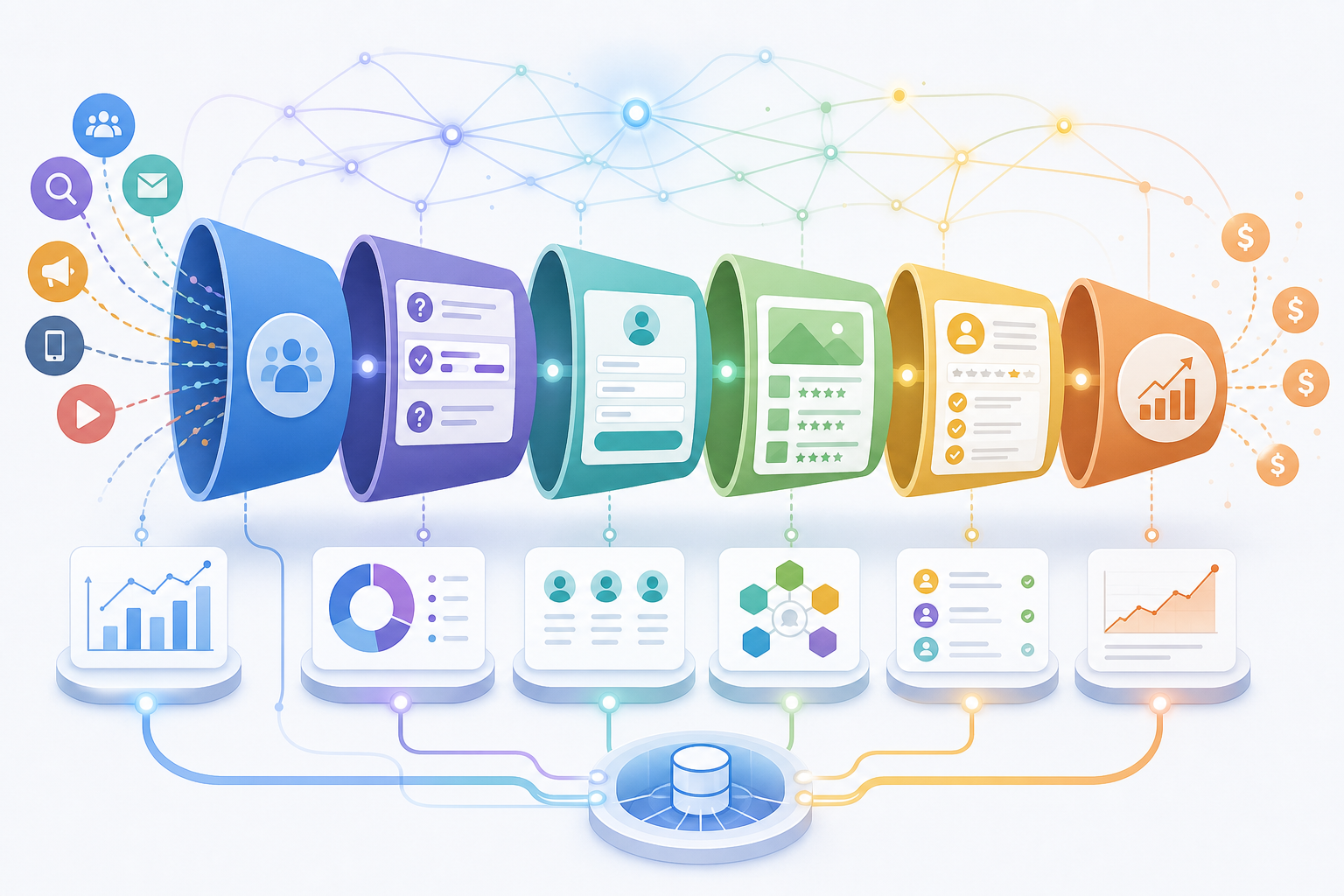
Completion rate is a diagnostic metric, not the ultimate objective. A quiz can achieve a high completion rate by asking trivial questions while producing weak recommendations and unqualified leads. Measurement should connect the top of the funnel to qualified pipeline or product revenue.
Use a stage-based event model
Track at least landing-page view, quiz start, meaningful question milestone, opt-in view, lead submission, result view, result call-to-action click, and final conversion. Ecommerce funnels should also track product view, add to cart, checkout, purchase, order value, and returns where possible. B2B funnels should connect submissions to qualified leads, meetings, opportunities, and closed revenue.
Use consistent event names and include quiz version, result ID, experiment variant, and attribution properties. Versioning is essential because a scoring change can alter lead quality even when the visible completion rate remains stable.
Calculate the metrics that expose bottlenecks
- Start rate: quiz starts divided by eligible landing-page visitors.
- Completion rate: result views divided by quiz starts.
- Lead capture rate: valid lead submissions divided by quiz starts or result views, with the denominator stated.
- Result action rate: primary call-to-action clicks divided by result views.
- Qualified lead rate: accepted or qualified leads divided by submitted leads.
- Recommendation conversion rate: purchases or booked actions attributed to a recommendation divided by result views.
- Revenue per quiz start: attributed net revenue divided by quiz starts.
- Cost per qualified outcome: campaign cost divided by qualified leads, purchases, or another commercially valid event.
Segment these metrics by traffic source, device, quiz result, new versus returning visitor, and version. An aggregate completion rate can hide a broken mobile question, an unprofitable Meta ads audience, or one result category that never converts.
Validate recommendation quality
Commercial conversion is not the only quality signal. Review product returns, cancellations, sales rejection reasons, support contacts, result overrides, and post-result feedback. If buyers frequently exchange the recommended product, the quiz may be optimizing immediate conversion at the expense of fit.
Periodically sample individual response paths. Confirm that the displayed explanation matches the answers and that downstream segments are correct. For consequential recommendations, recruit subject-matter experts to review edge cases and prohibited combinations.
Run controlled experiments
Prioritize tests using expected impact, evidence, and implementation risk. A high-abandonment question with no routing value is a stronger test candidate than a button-color preference. Run experiments long enough to observe the downstream metric, not just starts or leads.
Paid traffic tests require particular care. Meta ads delivery can shift audience composition while a quiz variant is running. Keep campaign conditions stable where possible, monitor source-level quality, and avoid declaring a winner from a small difference in lead capture if qualified lead rate moves in the opposite direction.
Design content for search and AI discovery
A public quiz landing page can support SEO when it clearly explains the decision, audience, methodology, and possible outcomes. Indexable supporting content should answer the questions people ask before choosing. Do not rely on an embedded application with no crawlable context.
For GEO and AI Overviews, publish concise definitions, explicit selection criteria, named frameworks, comparison tables, limitations, and verifiable methodology. These structures help ChatGPT, Perplexity, Gemini, and search engines extract an accurate answer. However, citation-friendly formatting cannot compensate for vague claims or an undisclosed affiliate ranking.
Frequently asked questions
What is the best quiz funnel builder for a small business?
The best option for a small business is usually a dedicated builder that can launch quickly, capture leads, assign useful segments, and connect to the existing email platform without custom development. Select based on the intended quiz type and integration, then test the full workflow. A template library is helpful, but reliable result logic and clean data handoff matter more.
Can ChatGPT build a quiz funnel for me?
ChatGPT can help define the audience, draft questions, propose answer categories, write result copy, and generate test cases. It is not by itself the complete funnel infrastructure. You still need a builder to host the experience, execute logic, capture consent, store or transfer data, track events, and display consistent recommendations. Human reviewers should validate scoring and product claims.
How many questions should a lead generation quiz have?
Use the fewest questions needed to produce a credible result and useful next step. Many lead-generation quizzes can achieve this with roughly five to ten scored or routing questions, but complexity should determine length. A ten-question quiz with relevant branching may feel faster than five dense questions. Measure abandonment by question instead of following a universal limit.
Should a quiz ask for an email before showing the result?
It depends on the strength of the value exchange. Asking before the result can increase captured leads but may lower trust or data quality. Showing a concise result first and offering an expanded report by email is often a practical compromise. Test opt-in position against qualified outcomes and revenue, not email volume alone.
What is the difference between a quiz funnel and a survey?
A survey primarily gathers information for the organization conducting the research. A quiz funnel uses answers to deliver an immediate individualized outcome and guide the participant toward a relevant next step. The same interface can support both, but their value exchange, scoring, result design, and performance metrics differ.
Do product recommendation quizzes increase conversion rates?
They can increase conversion when shoppers face meaningful choice complexity and the recommendations accurately reflect compatibility and preferences. They can reduce conversion when questions add friction, outcomes feel predetermined, or recommended products are unavailable. Evaluate incremental revenue, order value, returns, and customer satisfaction using a controlled test where feasible.
What data should a quiz funnel send to a CRM?
Send contact identifiers, consent status, stable answer properties, segment or score, recommended outcome, quiz and version IDs, completion timestamp, attribution fields, and the requested next action. Avoid sending sensitive or unnecessary free text. Document which system owns each property and how updates, duplicates, deletion requests, and integration failures are handled.