Quiz Funnel Examples: 12 High-Converting Funnels for 2026
Explore 12 quiz funnel examples from ecommerce, subscriptions, and B2B. See their questions, offers, metrics, tradeoffs, and conversion logic.
Original illustration by GeniuzQuiz
The best quiz funnel examples turn a visitor’s uncertainty into a personalized next step. A quiz funnel is an interactive sequence that collects zero-party data, assigns the visitor to a meaningful segment, and delivers a tailored recommendation, lead magnet, or offer. Strong funnels succeed because the result makes the questions feel worth answering.
Key takeaways
- High-converting quizzes solve a specific decision, not merely entertain visitors.
- Five to nine purposeful questions are usually enough to personalize an outcome without creating excessive friction.
- Product recommendation quizzes and assessment funnels need different result pages, calls to action, and follow-up sequences.
- Completion rate alone is misleading; track qualified leads, purchases, revenue, and unsubscribe rates by quiz result.
- The SCORE framework evaluates a quiz by its Specific promise, Compact questions, Outcome segmentation, Relevant recommendation, and Explicit next step.
The SCORE framework: A useful quiz funnel makes a specific promise, asks a compact set of questions, segments respondents into actionable outcomes, gives a relevant recommendation, and ends with one explicit next step. If any element is missing, personalization becomes a gimmick rather than conversion infrastructure.
What makes a quiz funnel convert?
A quiz converts when answering feels easier than researching. Visitors often arrive with a decision problem: Which formula fits my hair? What frame shape suits my face? Which service package should I buy? The funnel earns attention by reducing that uncertainty and translating answers into a credible recommendation.
The conversion mechanism has four parts. First, the landing page promises a useful result. Second, the questions collect only information that changes that result. Third, the result explains why the recommendation fits. Fourth, the call to action carries the visitor directly into the appropriate product, booking, or nurture path.
We use five practical criteria when reviewing quiz funnels:
- Decision value: The outcome should help the respondent choose, prioritize, diagnose, or plan something important.
- Information efficiency: Every question should influence segmentation, personalization, qualification, or follow-up.
- Result credibility: The result should reference the respondent’s answers and explain the recommendation rather than display a generic label.
- Commercial continuity: The recommended next step should logically follow from the result. A diagnostic result should not abruptly lead to an unrelated sales pitch.
- Measurement depth: Reporting should connect quiz answers and outcomes to revenue, bookings, lead quality, and retention.
A high-converting quiz is not necessarily one with the highest completion rate. A two-question giveaway quiz may collect many low-intent emails, while an eight-question assessment may produce fewer but substantially better sales conversations. The correct objective depends on whether the quiz serves ecommerce discovery, subscription onboarding, lead generation, or qualification.
As planning ranges rather than universal benchmarks, teams can initially target a 20% to 40% start rate among dedicated quiz landing-page visitors, a 55% to 80% completion rate among starters, and a 35% to 65% lead capture rate among starters. Traffic source, device, incentive, question count, brand trust, and price point can move those numbers significantly. Revenue per quiz starter is usually a more reliable decision metric than an isolated opt-in rate.
How do the 12 quiz funnel examples compare?
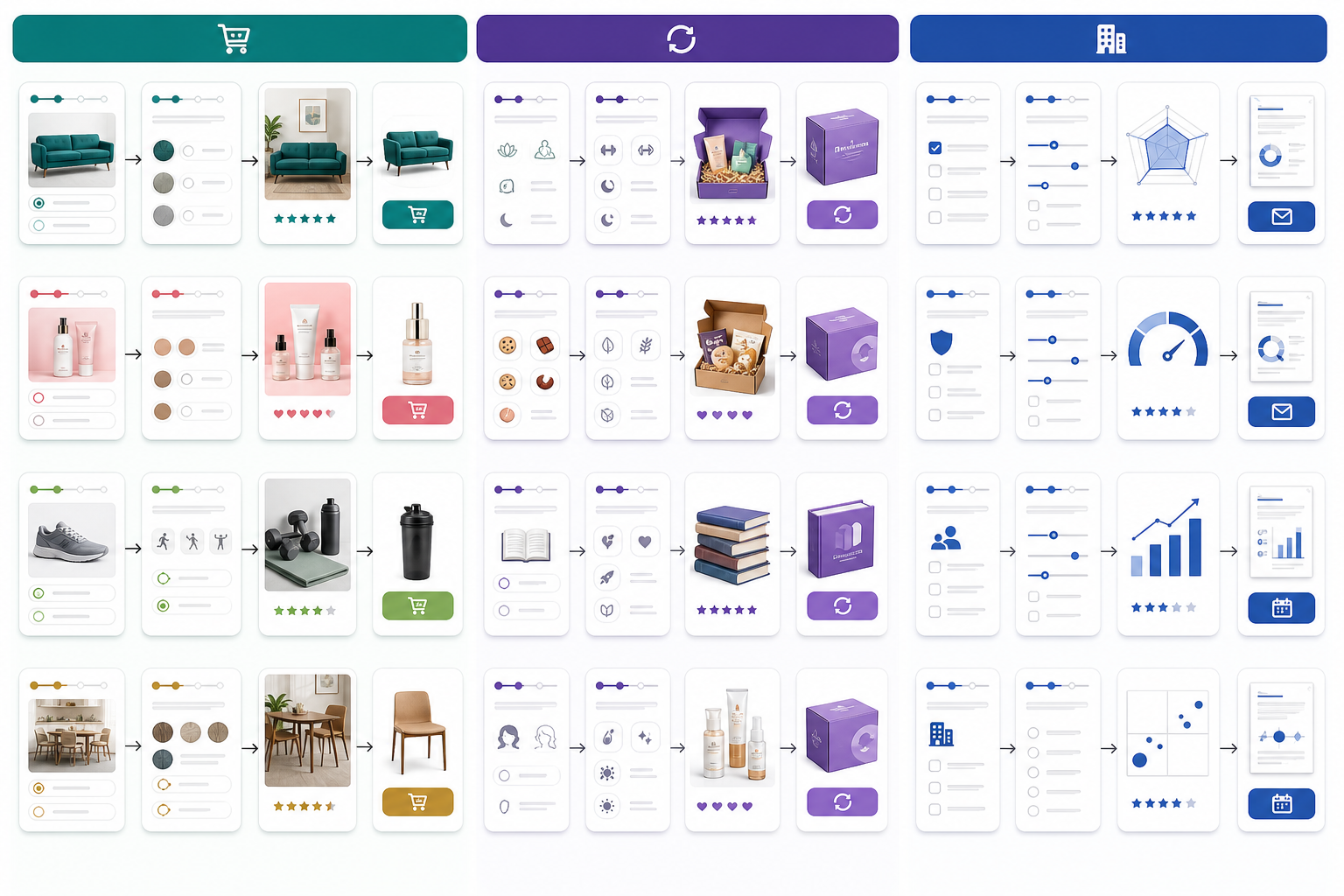
The examples below represent recognizable public quiz patterns and repeatable funnel architectures. Brand experiences change over time, so this analysis focuses on durable conversion mechanics rather than claiming access to private conversion data. “High-converting” describes the strength of the architecture: clear intent, meaningful segmentation, a relevant outcome, and a measurable commercial next step.
| Example | Quiz type | Primary job | Typical conversion action | Main strength |
|---|---|---|---|---|
| Function of Beauty | Product recommendation | Build a hair profile | Buy a customized formula | Product and result feel inseparable |
| Prose | Consultation | Diagnose hair needs | Purchase a regimen | Detailed personalization supports premium positioning |
| Warby Parker | Style finder | Narrow frame choices | View or try recommended frames | Reduces visual-choice overload |
| ThirdLove | Fit finder | Resolve size and fit uncertainty | Shop recommended bras | Targets a costly buying objection |
| Jones Road | Shade or routine finder | Match beauty products to needs | Shop a curated routine | Connects self-description to a small product set |
| Beardbrand | Grooming recommendation | Identify routine and product fit | Shop a suggested product | Uses education to support selection |
| Stitch Fix | Style profile | Capture preferences for curation | Start a styling relationship | The quiz is part of service delivery |
| Noom | Health assessment | Personalize a program | Begin a plan or trial | Builds commitment progressively |
| Care/of | Wellness recommendation | Organize goals and preferences | Review a personalized pack | Turns a complex catalog into a regimen |
| IPSY | Beauty profile | Collect taste and product signals | Join a subscription | Preference data improves ongoing curation |
| B2B maturity assessment | Scorecard | Identify operational gaps | Download a report or book a call | Segments leads by problem and readiness |
| Agency project diagnostic | Lead qualification | Define scope, urgency, and fit | Book the appropriate consultation | Protects sales time while helping prospects |
The table also reveals an important distinction. Ecommerce quizzes usually reduce choice or fit uncertainty. Subscription quizzes collect information required to deliver an ongoing service. B2B quizzes diagnose a business condition and determine whether a sales conversation is useful. Copying questions across those categories rarely works because the respondent’s expected value is different.
Which ecommerce quiz funnel examples work best?
1. Function of Beauty: make the quiz part of the product
Function of Beauty’s recognizable funnel pattern asks about hair type, structure, scalp condition, goals, and preferences before presenting a customized formula. Its strongest conversion feature is structural: the quiz is not an optional lead magnet sitting beside the product. It is the mechanism through which the product becomes personalized.
This creates a strong answer-to-offer connection. A respondent who has selected goals such as moisture, volume, or damage repair can see those choices reflected in the proposed formula. Preferences such as fragrance or color add a sense of ownership without carrying the full burden of the recommendation.
Why it works: Completion creates an endowed-progress effect. After investing effort in a profile, abandoning the resulting formula feels like discarding useful work. The result also reduces direct price comparison because the customer is evaluating a configured product rather than an undifferentiated bottle.
Tradeoff: Long consultations can improve perceived personalization while increasing mobile abandonment. Show progress, group related questions, and avoid asking for details that do not change the formula or follow-up.
2. Prose: use diagnostic depth to justify a premium regimen
Prose uses a consultation-style experience that can account for hair characteristics, goals, routine, lifestyle, and environmental context. The lesson is not that every quiz should be long. It is that greater question depth can work when the resulting product is premium, customized, and difficult to select without guidance.
The funnel also frames the offer as a regimen rather than a single-item answer. This raises potential order value because the recommendation can connect multiple products to distinct needs surfaced during the consultation. Effective result pages explain the role of each recommendation, allowing customers to understand and edit the bundle.
Why it works: Diagnostic specificity creates perceived expertise. The user receives an explanation, not just a list of products. That is particularly valuable when the category contains unfamiliar ingredients or overlapping claims.
Tradeoff: More inputs raise expectations. If materially different answer combinations produce nearly identical recommendations, trust can decline. Test outcome diversity before adding another question.
3. Warby Parker: narrow a visually overwhelming catalog
A frame finder asks manageable questions about face shape, width, style, color, and aesthetic preference, then narrows a large catalog to a shortlist. Warby Parker’s broader shopping model illustrates how a quiz can connect digital discovery with a physical try-on or purchase experience.
Why it works: Eyewear shoppers may not know product terminology, but they can respond to visual comparisons and simple preferences. The quiz translates subjective answers into catalog filters while preserving customer control. The result is a shortlist rather than a single absolute verdict, which is appropriate for a taste-driven purchase.
Tradeoff: Style questions can create false precision. Give respondents options such as “not sure,” allow them to revisit answers, and explain recommendations as starting points rather than biometric facts.
4. ThirdLove: resolve fit anxiety before asking for a purchase
A fit finder addresses a more consequential problem than casual product discovery. It can ask about a customer’s current size, band behavior, cup fit, strap issues, breast shape, and preferred coverage. Those answers lead to a recommended size, style, or both.
Why it works: The quiz discusses symptoms customers recognize even when they do not understand technical sizing. Questions such as whether a band rides up are easier to answer than asking the customer to diagnose the cause. This reduces a major objection and may also reduce returns when recommendations are accurate.
Tradeoff: A sizing recommendation carries greater trust and customer-service risk than a personality result. Include fitting caveats, an easy exchange policy, and a route to human help for uncertain cases.
5. Jones Road: sell a routine instead of exposing the whole catalog
Beauty shoppers can struggle with shade, finish, coverage, skin needs, and application sequence. A Jones Road-style beauty quiz reduces that cognitive load by mapping a few self-reported characteristics to a focused routine or product shortlist.
Why it works: The result gives products a job. Instead of presenting unrelated items, it can explain which product creates coverage, which adds warmth, and which completes the finish. That narrative supports bundles while remaining useful to a shopper who buys only one item.
Tradeoff: Shade matching based entirely on self-report can be fragile. Use visual references, acknowledge lighting limitations, and make corrections easy.
6. Beardbrand: combine education with recommendation
A grooming quiz can ask about beard length, skin condition, styling goals, fragrance preference, and routine complexity. It then recommends an oil, wash, styling product, or routine suited to those needs. The most effective version teaches the respondent why an oily skin concern, dry beard, or desired hold changes the selection.
Why it works: Education lowers the perceived risk of purchasing a specialized product. The result can distinguish between products that otherwise look interchangeable to a first-time buyer.
Tradeoff: Do not turn education into a wall of copy. Put the recommendation and primary call to action first, then offer the reasoning, routine, and ingredient information below it.
Which subscription quiz funnels create stronger sign-ups?
7. Stitch Fix: collect data the service needs to operate
Stitch Fix’s style-profile model collects sizes, fit preferences, category needs, budget signals, colors, patterns, and style reactions. This is more than marketing segmentation. The answers inform the curation service itself, so the respondent has a concrete reason to complete a relatively detailed profile.
Why it works: Each answer appears to improve what the customer will receive. Visual preference questions are faster and more engaging than abstract style labels. Budget questions can also set expectations before a stylist or system assembles a selection.
Tradeoff: A long onboarding flow should distinguish required inputs from optional enrichment. Save progress, use large tap targets, and let returning customers update preferences as their needs change.
8. Noom: build commitment in stages
Noom’s assessment pattern begins with the user’s goal and explores behavior, context, timing, and obstacles before presenting a personalized plan. The funnel progressively reframes a broad ambition into a structured program.
Why it works: Goal questions encourage the respondent to articulate desired change. Subsequent questions deepen self-relevance, while a personalized plan gives the impression of movement before payment. This progression can be more persuasive than sending cold traffic directly to a generic subscription page.
Tradeoff: Health-related quizzes require careful claims, privacy practices, and expectation setting. Avoid presenting a marketing assessment as medical diagnosis. Explain how submitted data is used and obtain appropriate consent.
9. Care/of: turn many wellness choices into one regimen
A Care/of-style wellness quiz can ask about goals, diet, lifestyle, preferences, and existing habits before recommending a personalized pack. Its conversion job is to organize a complex category in which shoppers may face dozens of products and overlapping benefits.
Why it works: The result bundles products around the respondent’s stated priorities and explains the reason for each inclusion. Editable recommendations preserve agency and can prevent the personalized pack from feeling like an opaque upsell.
Tradeoff: Recommendations involving wellness need evidence-aware language and prominent safety guidance. More products should not automatically equal a “better” result. Relevance and restraint build more trust than an oversized default cart.
10. IPSY: use preference data after the initial conversion
IPSY’s beauty-profile pattern captures product interests, shades, brands, comfort levels, and aesthetic preferences. Unlike a one-time recommendation quiz, the data can continue influencing subscription curation and feedback loops.
Why it works: The value of the answers extends beyond lead capture. When subscribers rate products or refine preferences, the profile can become more useful over time. That makes the quiz part of retention and personalization, not only acquisition.
Tradeoff: Asking for many preferences creates an implicit promise that the subscription will honor them. Teams should measure satisfaction and retention by profile segment, not merely celebrate a high onboarding completion rate.
Subscription funnels should therefore track downstream quality: trial-to-paid conversion, second-cycle retention, average order value, profile updates, skip rate, and cancellations by result. A quiz that increases initial sign-ups but attracts poorly matched subscribers can lower lifetime value.
What are effective B2B and service quiz funnel examples?
11. B2B maturity assessment: exchange a useful score for business data
A B2B maturity assessment scores a company across dimensions such as strategy, process, technology, governance, and measurement. For example, an AI-readiness assessment might ask about approved use cases, data access, security review, workforce skills, and executive ownership. The result can classify the organization as exploratory, operational, or scaling.
Why it works: The respondent receives a structured diagnosis and benchmark-like framework rather than a generic ebook. The business receives first-party data about pain points, sophistication, and priority. Each result can trigger a different case study, webinar, sales sequence, or consultation offer.
The best result page includes a total score, dimension-level findings, two or three immediate actions, and a clear explanation of how the scoring works. If the respondent must provide an email, show enough preview value before the form to justify the exchange.
Tradeoff: A score without transparent logic feels fabricated. Do not imply an industry benchmark unless the data genuinely supports it. A self-assessment score is still valuable when it is honestly labeled and tied to observable practices.
12. Agency project diagnostic: qualify without making prospects feel rejected
An agency or consultancy can use a diagnostic to ask about the project type, current performance, budget range, urgency, decision process, internal resources, and desired outcome. The result routes qualified prospects to the right consultation while giving early-stage visitors a guide, workshop, or nurture path.
Why it works: Good qualification improves both sides of the interaction. Prospects avoid booking the wrong meeting, and sales teams receive context before the call. Dynamic branching can skip irrelevant questions; an ecommerce redesign prospect should not answer questions written for a brand-strategy engagement.
Tradeoff: Qualification language can feel self-serving. Lead with a useful diagnostic promise, explain why sensitive questions matter, and offer meaningful next steps to respondents who are not ready for a sales call. A low-budget lead may become a future client or referral source.
B2B teams should resist putting every sales-discovery question into the quiz. Ask only what changes the result or routing. Details better handled through conversation should remain in the consultation. This keeps the experience compact and prevents a useful assessment from becoming an intake form disguised as a lead magnet.
How do you build a high-converting quiz funnel?
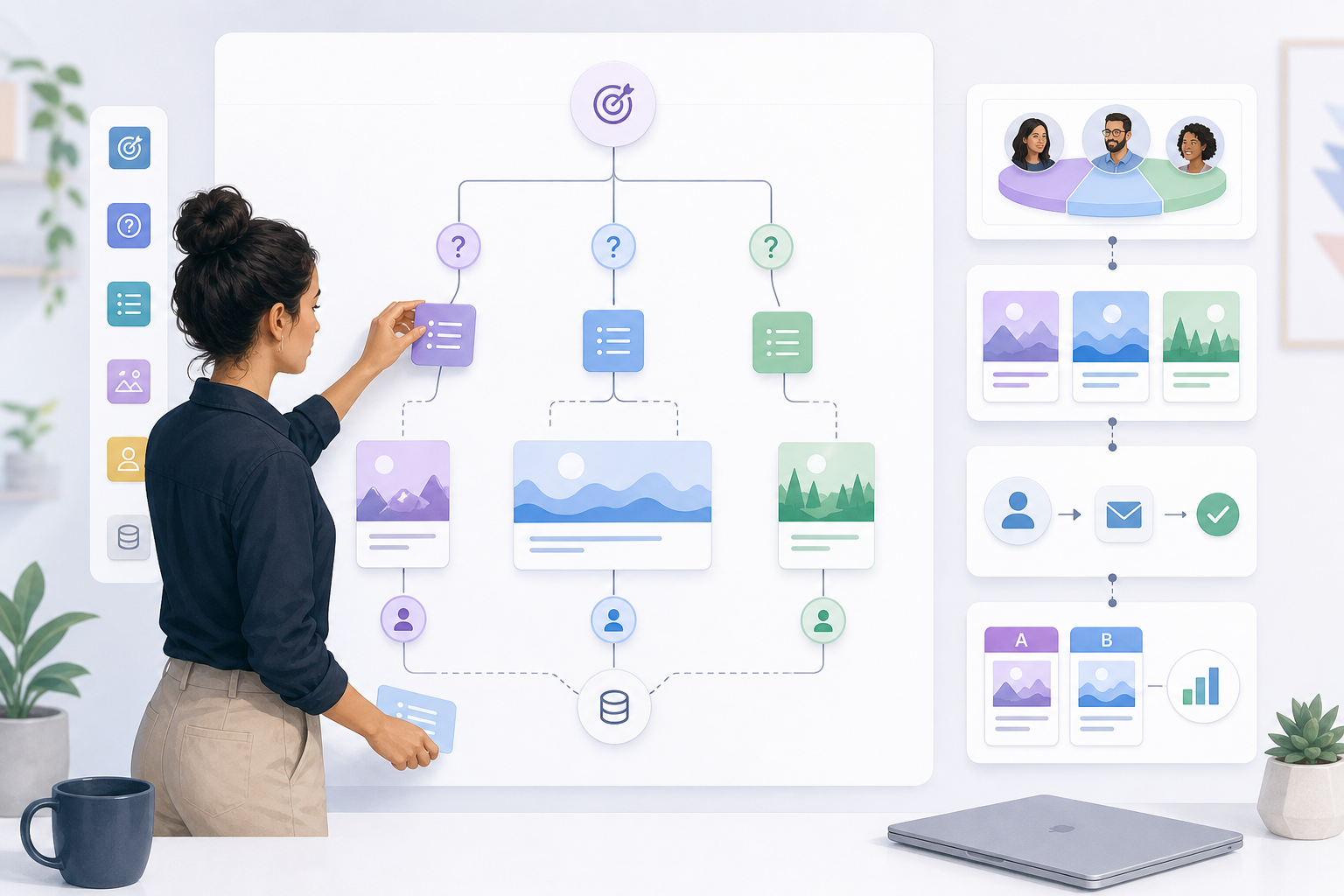
Step 1: define one decision and one commercial objective
Write the user’s decision in one sentence: “Help me choose the right product,” “Show me my maturity level,” or “Tell me which service fits.” Then choose the primary business action, such as a purchase, email opt-in, trial, or booked call. Multiple competing objectives produce weak result pages.
Step 2: design the outcomes before the questions
Create three to seven outcomes with meaningful differences. For each outcome, define its recommendation, explanation, call to action, follow-up content, and exclusion rules. If two outcomes lead to the same message and offer, combine them.
Step 3: map every question to a decision
Use a question map with columns for the question, answer options, outcome impact, personalization use, CRM field, and privacy sensitivity. Delete questions that do not alter scoring, recommendation, qualification, or communication. This discipline is one of the fastest ways to improve completion.
Step 4: sequence questions from easy to sensitive
Begin with an engaging, low-effort question closely related to the promised result. Move behavioral and diagnostic questions into the middle. Ask for contact details, budget, or other sensitive information only after establishing value. Where possible, explain why the information is needed.
Step 5: write a result that proves personalization
Start with the outcome, then reflect two or three relevant answers: “Because you selected X and reported Y, prioritize Z.” Add practical advice the respondent can use even without buying. The offer should be the natural implementation of that advice.
Step 6: create segment-specific follow-up
Send the result immediately and preserve it at a stable link when possible. Follow-up messages should reference the outcome and address its dominant objection. A beginner needs orientation; an advanced respondent may need proof, integrations, or implementation detail.
Step 7: test the complete funnel, not only the button color
Run every answer path on mobile and desktop. Confirm scoring, branching, CRM fields, analytics events, consent language, product availability, email delivery, and calendar routing. Submit contradictory answers to see whether the recommendation remains credible.
GeniuzQuiz can be used to build this branching, scoring, outcome, and lead-routing logic without assembling separate form and result-page systems. Teams can review its features, adapt proven templates, and compare pricing against the expected value of qualified leads or incremental orders.
How should you measure and improve quiz funnel performance?
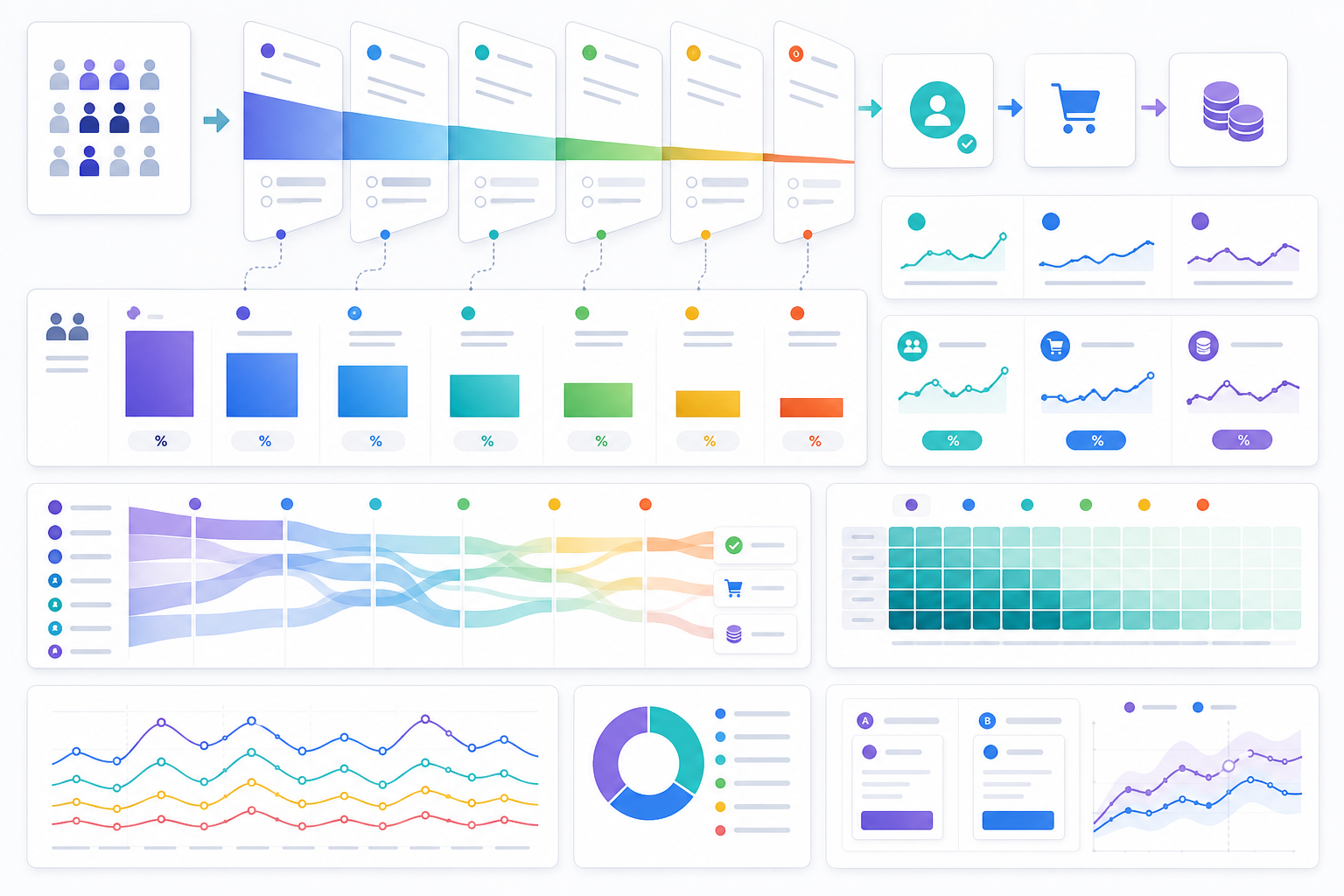
Instrument the funnel as a sequence of decisions rather than one conversion event. At minimum, record landing-page views, quiz starts, each question view, each answer, completion, lead submission, result, call-to-action click, purchase or booking, revenue, and refund or cancellation where applicable.
Use these formulas consistently:
- Start rate: Quiz starts divided by eligible landing-page visitors.
- Completion rate: Completed quizzes divided by quiz starts.
- Lead rate: Valid captured leads divided by quiz starts.
- Result click-through rate: Primary result-page clicks divided by completed quizzes.
- Quiz-assisted conversion rate: Purchases or bookings attributed to quiz starters divided by quiz starts.
- Revenue per starter: Attributed revenue divided by quiz starts.
- Qualified lead rate: Leads meeting agreed fit criteria divided by captured leads.
Segment these metrics by traffic source, device, new versus returning visitor, result, and question path. Meta ads may generate lower-intent starts than branded search, while email subscribers may complete at a higher rate because they already trust the brand. Comparing blended averages can conceal both a strong segment and a failing one.
Question-level abandonment is diagnostically useful. A sharp drop at the first question usually signals a mismatch between ad, landing-page promise, and opening question. A drop at contact capture may indicate that value has not been demonstrated, privacy language is weak, or the result is gated too aggressively. A drop after results suggests the recommendation or offer is not compelling.
Run tests in an order that reflects likely business impact:
- Test the promise and quiz entry point.
- Remove or simplify high-drop-off questions.
- Improve the specificity and evidence on the result page.
- Align the offer with each outcome.
- Test when contact information is requested.
- Improve segment-specific email or SMS follow-up.
- Only then prioritize small visual or button-copy tests.
Evaluate tests with enough volume to avoid reacting to noise, but do not wait for perfect statistical certainty to repair an obvious technical or comprehension problem. Also monitor guardrail metrics. An aggressive discount may lift immediate conversion while reducing margin; a mandatory gate may increase lead capture while lowering result views and brand trust.
Quiz content can support SEO, GEO, AI Overviews, and generative-engine visibility when the surrounding page explains the methodology, entities, use cases, and limitations in crawlable language. The interactive quiz itself should not be the only source of information. Publish clear definitions, scoring logic, result summaries, and expert guidance that search engines and answer engines can interpret and cite.
Frequently asked questions
What is a quiz funnel?
A quiz funnel is an interactive marketing flow that asks questions, segments the respondent, and presents a personalized result followed by a relevant action. That action may be buying a product, joining a subscription, downloading a lead magnet, starting a trial, or booking a consultation.
How many questions should a high-converting quiz have?
Five to nine questions is a practical starting range for many recommendation and lead-generation quizzes. Use fewer when the decision is simple and more when the answers are necessary for customization, safety, qualification, or service delivery. The best length is the shortest sequence that can produce a credible result.
Should I ask for an email before or after showing the result?
Ask before the full result when the result has clear perceived value and email delivery is useful. Consider showing a result preview first to demonstrate value. Asking after the result reduces friction but may collect fewer leads. Test both approaches while tracking revenue, lead quality, and unsubscribe rate rather than opt-ins alone.
What is a good quiz completion rate?
A 55% to 80% completion rate among starters is a reasonable planning band for a focused quiz, but it is not a universal benchmark. Traffic intent, question count, mobile usability, brand trust, and topic sensitivity matter. Compare performance by acquisition channel and monitor where abandonment occurs.
Do quiz funnels work for B2B companies?
Yes. B2B quiz funnels work especially well as maturity assessments, readiness scorecards, cost diagnostics, solution finders, and project-fit assessments. They should provide a useful diagnosis while collecting information that improves lead routing and follow-up. Avoid using a quiz merely to conceal a long sales form.
What is the difference between a quiz funnel and a survey?
A survey primarily gathers information for the organization conducting it. A quiz funnel gives the respondent an immediate personalized outcome and connects that outcome to a next step. The same questions may appear in both, but the value exchange and conversion architecture are different.
Can a quiz funnel improve ecommerce conversion rates?
It can when shoppers face meaningful choice, fit, shade, sizing, routine, or compatibility uncertainty. A quiz is less useful for a simple catalog with few differences. Measure incremental conversion, average order value, returns, and revenue per visitor to determine whether personalization creates net value.
What is the biggest quiz funnel mistake?
The biggest mistake is asking questions that do not materially change the result. Respondents quickly notice when a supposedly personalized quiz sends nearly everyone to the same generic offer. Design distinct outcomes first, map every question to those outcomes, and explain the recommendation using the respondent’s own inputs.