Quiz Funnel Template: Questions, Logic, Results & Copy
Use this quiz funnel template to plan high-converting questions, branching logic, result pages, lead capture, and persuasive follow-up copy.
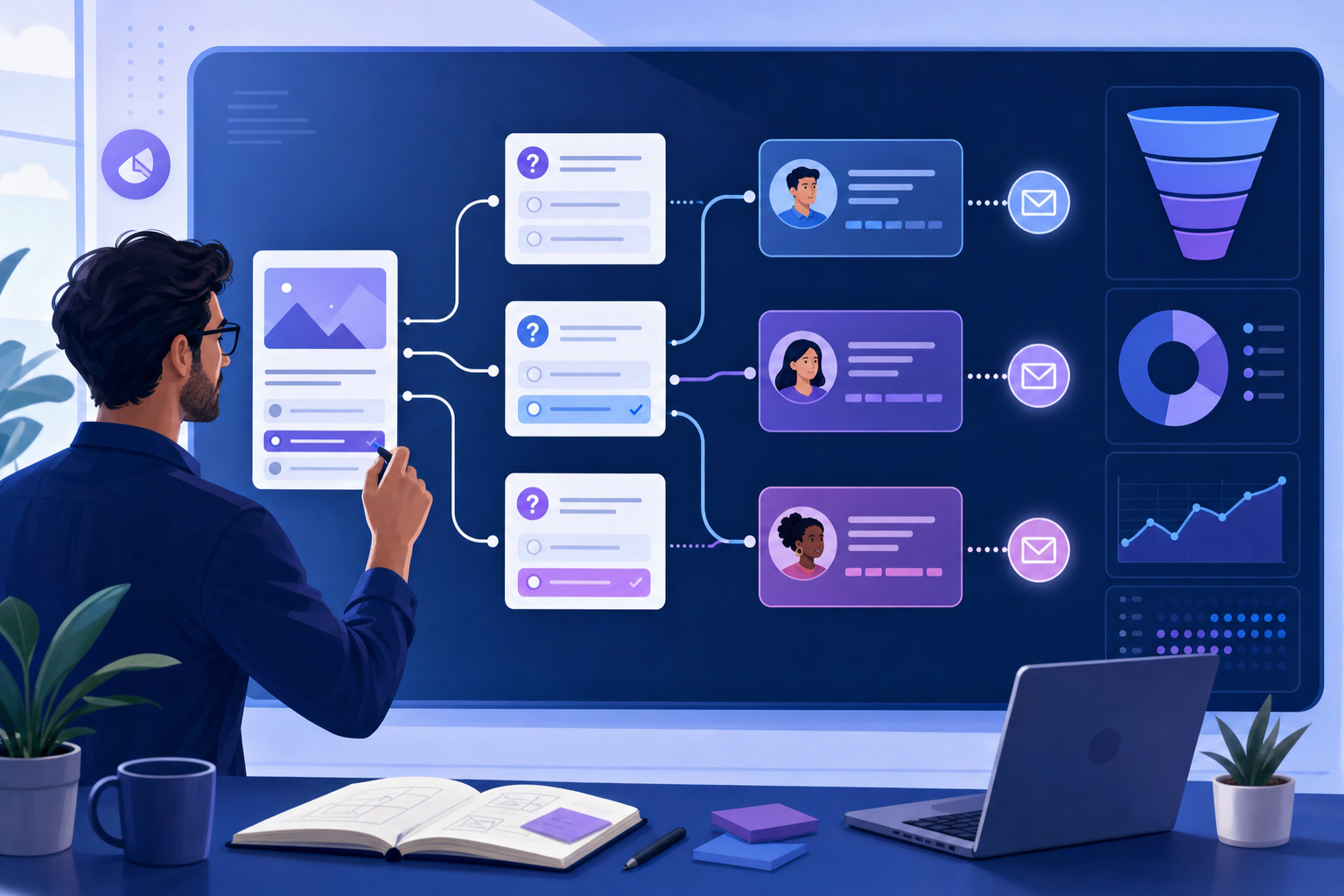
Original illustration by GeniuzQuiz
A quiz funnel template is a reusable plan for attracting a prospect, asking diagnostic questions, adapting the path, capturing the lead, presenting a relevant result, and triggering follow-up. Use the template below to write every question, branch, result page, email, and call to action before building the funnel in software.
Key takeaways
- Start with one audience, one decision, and one primary conversion goal.
- Use five to eight purposeful questions rather than collecting data you will not act on.
- Branch only when an answer should change the next question, result, offer, or follow-up.
- Write results as useful recommendations, not vague personality labels.
- Segment follow-up by result and buying readiness, then measure completion, lead capture, and qualified conversion rates.
The QBRF framework stands for Qualify, Branch, Recommend, and Follow up. A productive quiz funnel qualifies the visitor with a small set of useful signals, branches when relevance improves, recommends a credible next step, and follows up according to the visitor's result and intent.
What is a quiz funnel, and what should its template include?
A quiz funnel is an interactive lead-generation and sales journey that uses a sequence of questions to classify a visitor and deliver a personalized recommendation. Unlike a static lead magnet, it exchanges immediate relevance for information: the visitor receives a diagnosis, score, product match, plan, or next step, while the business gains declared first-party data.
A complete template should cover more than the questions. It should define the promise that earns the first click, the answer options that power segmentation, the rules used to calculate results, the lead-capture moment, the result-page copy, the offer, and the automated follow-up. Omitting any of those components produces a quiz that may entertain people without moving them toward a commercial decision.
Before writing, complete this one-sentence strategy statement:
We help [specific audience] discover [useful answer] by asking about [three to five decision factors], then recommend [next step or offer] based on [scoring or segmentation method].
For example: We help independent consultants discover their strongest lead-generation system by asking about audience size, sales cycle, offer value, traffic source, and available time, then recommend a 30-day acquisition plan based on fit and readiness.
The answer must matter to the visitor even if that person does not buy. That standard separates a useful diagnostic from a disguised contact form. It also makes the quiz easier to promote through organic search, email, partner campaigns, or Meta ads because the promise is specific enough to understand in seconds.
| Template component | Its job | Practical rule |
|---|---|---|
| Quiz promise | Earn the start | Promise one clear discovery or recommendation |
| Questions | Collect decision signals | Ask only what changes segmentation or advice |
| Branching logic | Keep the path relevant | Create a branch only when the experience should change |
| Lead capture | Identify and segment the prospect | Explain what is delivered after submission |
| Result page | Interpret the answers | Give insight before presenting the offer |
| Follow-up | Continue the personalized journey | Reference the result and recommend one next action |
| Analytics | Reveal friction and revenue impact | Track each stage, not merely total leads |
What is the complete quiz funnel template?
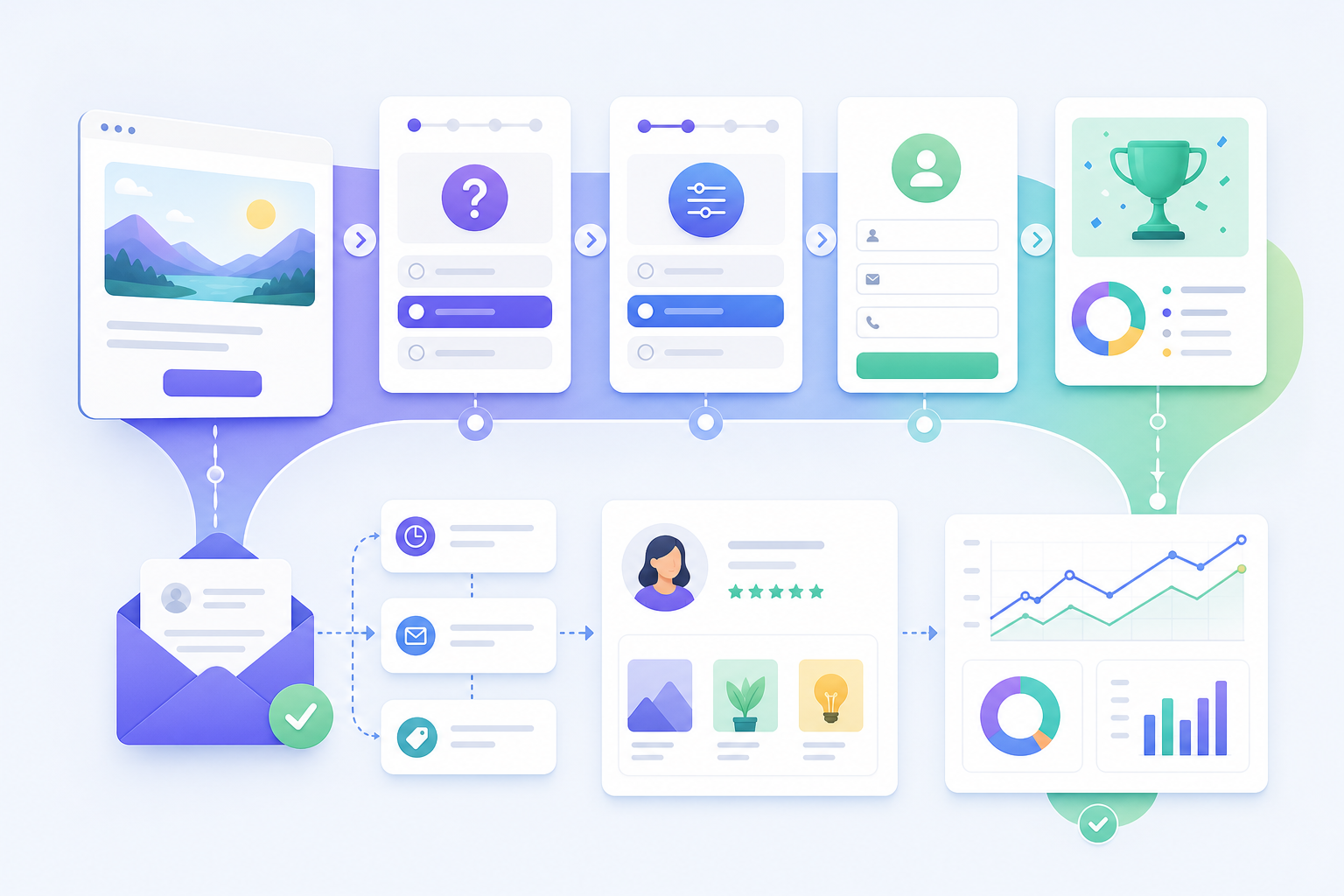
Use the following fill-in-the-blank template as a working brief. A strategist, copywriter, designer, and automation specialist should be able to review it and understand the complete journey without guessing what happens after each answer.
Step 1: Define the conversion goal
Primary audience: [Who should take the quiz?]
Visitor's decision: [What are they trying to choose, fix, understand, or prioritize?]
Primary conversion: [Book a consultation, request a quote, start a trial, buy a product, or join an email sequence]
Secondary conversion: [Download a guide, view a plan, compare options, or save results]
Qualified lead criteria: [Budget, need, timing, authority, use case, location, or product fit]
Choose one primary conversion. Asking quiz takers to book a call, browse six products, follow three social accounts, and download two guides divides attention. Secondary actions can exist, but the result page should visually and verbally prioritize one next step.
Step 2: Write the opening screen
Headline: Discover your [result] in [time or number of questions].
Supporting copy: Answer [number] quick questions to get a personalized [recommendation, score, plan, or product match] based on your [situation, goal, or preferences].
Button: Get my recommendation.
Expectation line: Takes about [time]. No specialist knowledge required.
An opening screen should reduce uncertainty, not explain the company's history. State what the visitor gets, how much effort is required, and why the outcome is relevant. If traffic comes from an advertisement, preserve message continuity. A Meta ad promising a two-minute skincare routine finder should not lead to a generic wellness assessment.
Step 3: Map the question sequence
Question 1, easy context: Which best describes your [role, situation, category, or goal]?
Question 2, desired outcome: What would you most like to achieve in the next [time frame]?
Question 3, obstacle: What is currently making that difficult?
Question 4, behavior: Which approach are you using now?
Question 5, preference: Which factor matters most when choosing a solution?
Question 6, readiness: When do you want to address this?
Optional qualification question: What is your approximate [budget, volume, team size, or frequency]?
This sequence moves from low-friction context to more commercially sensitive information. It feels like a consultation rather than an interrogation. When a sensitive question is necessary, explain why: for example, “This helps us avoid recommending a plan that is too basic or unnecessarily expensive.”
Step 4: Insert the lead-capture screen
Headline: Your personalized [result] is ready.
Body copy: Enter your email to see your result and receive the [checklist, plan, comparison, or recommendations] you can use next.
Fields: First name and email by default; request a phone number only when it supports the promised next step.
Button: Show my result.
Consent copy: Clarify what emails the person will receive and provide any consent language required for the audience and jurisdiction.
Capture forms placed immediately before results often work because the quiz taker has invested effort and expects a personalized payoff. That does not justify hiding a weak result behind a form. The perceived value of the promised output must exceed the perceived cost of sharing contact details.
Step 5: Outline each result
Result name: [Specific, positive, recognizable label]
One-sentence diagnosis: Based on your answers, your strongest opportunity is [opportunity], while [constraint] is the issue most likely to slow progress.
Why this result fits: Reference two or three answer patterns.
Three recommended actions: Give an immediate action, a strategic action, and an offer-related action.
Primary call to action: [Action verb] your [next step].
Risk reducer: Explain time, price, commitment, eligibility, or what happens after clicking.
Step 6: Connect automation and tracking
Assign each result, intent level, and important answer a stable field or tag. Send those fields to the email platform, CRM, analytics system, and advertising platform where consent permits. GeniuzQuiz can be used to build the interactive journey and connect questions, outcomes, and lead data; its features should be evaluated against the branching and integration requirements in the brief.
At minimum, track quiz view, quiz start, each question reached, quiz completion, form view, form submission, result viewed, primary call-to-action click, booked call or purchase, and revenue. Without stage-level events, a low sales count cannot be diagnosed: the underlying problem could be traffic quality, opening-screen copy, an awkward question, lead-form friction, poor recommendations, or a weak offer.
How do you write quiz questions and branching logic?
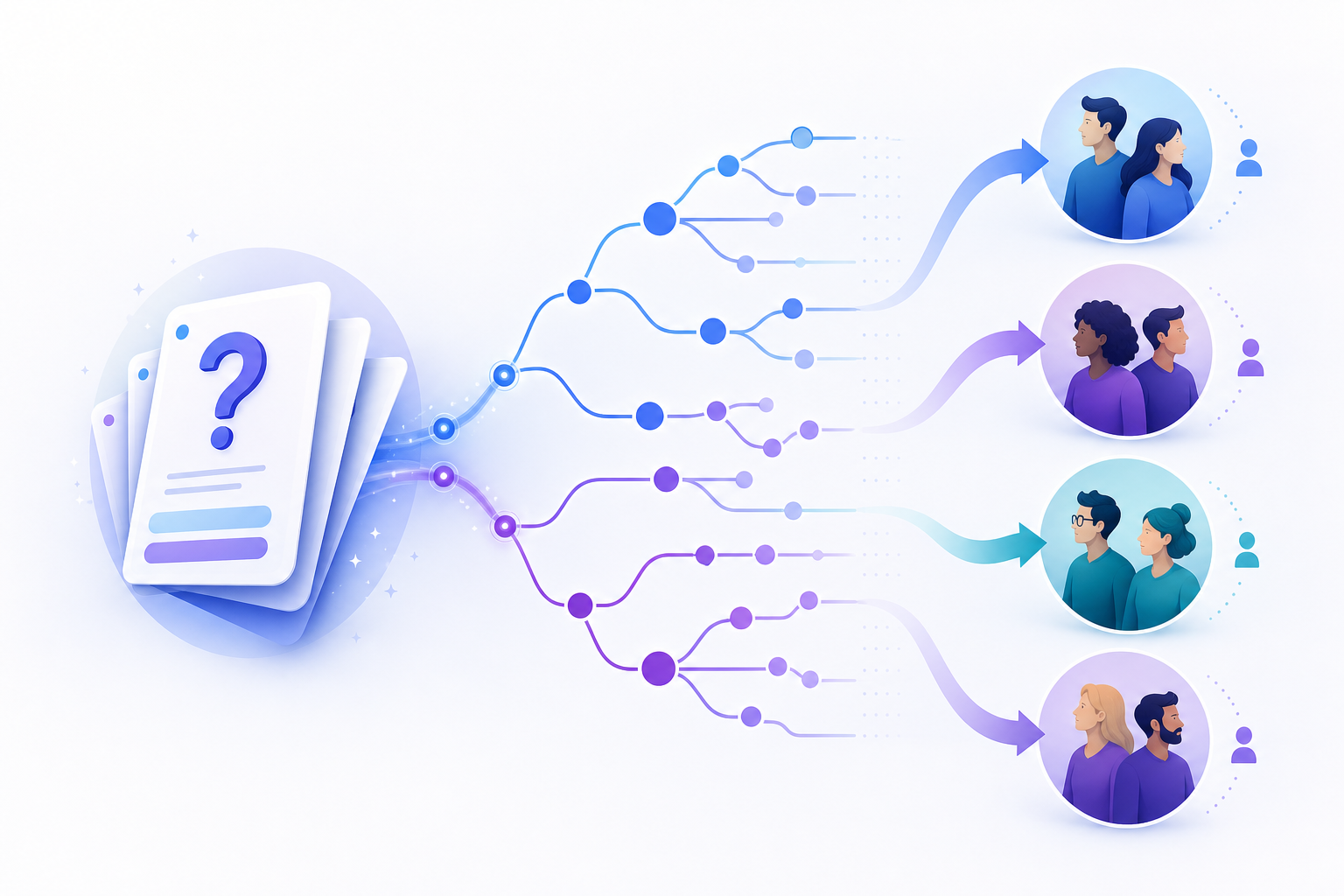
Every question should perform at least one of four jobs: identify fit, reveal intent, determine a recommendation, or personalize the follow-up. If an answer is merely interesting to the marketer, remove it. Shorter is not automatically better, but irrelevant is always expensive.
Use answer options that are distinct and complete
Answer choices should not overlap so much that two options feel equally correct. They should also include the common situations represented in the target audience. When the list cannot be exhaustive, add “Something else” or “Not sure yet” rather than forcing an inaccurate answer.
Weak question: What is your biggest marketing challenge?
Stronger question: Which issue is most responsible for missed revenue right now?
- Not enough qualified traffic reaches our offer.
- Visitors arrive, but few become leads.
- Leads enter our pipeline, but few book or buy.
- Customers buy once but rarely return.
- I do not yet know where the biggest leak is.
The stronger version creates operationally useful segments. Each answer can trigger different advice, proof, and follow-up rather than producing a generic marketing result.
Choose the right logic model
Most funnels use one or a combination of three models:
| Logic model | Best for | How it works | Main tradeoff |
|---|---|---|---|
| Category tally | Personality types, strategies, or broad profiles | Each answer adds points to one or more result categories | Ties and generic outcomes require careful handling |
| Weighted scoring | Readiness, risk, maturity, or qualification | Answers receive values, weights, or thresholds | Scoring can imply false precision if unsupported |
| Rule-based branching | Product matching, eligibility, or complex services | Specific answers show, hide, include, or exclude later paths | Too many rules become difficult to test and maintain |
Category tally is usually the simplest model for a content-led quiz. Weighted scoring works when some signals matter more than others. Rule-based logic is appropriate when one response genuinely changes eligibility or removes an entire class of recommendations.
Apply the Branch Value Test
Before creating a branch, ask: Will this answer change the next question, the final result, the recommended offer, or the follow-up message? If it changes none of them, store the answer without branching. This Branch Value Test prevents a common failure mode: an impressive-looking decision tree that creates maintenance work without improving relevance.
For example, a business software quiz might ask whether the visitor is self-employed, manages a small team, or leads a larger department. Team size could change the questions about permissions and collaboration, the recommended plan, the case study shown on the result page, and the sales routing. That is a valuable branch.
By contrast, asking the visitor's favorite productivity style may not affect any recommendation. It can make the quiz feel customized while producing no material benefit. Personalization should be consequential, not decorative.
Control the number of paths
A six-question quiz with four choices per question has 4,096 possible answer combinations, but it should not require 4,096 manually written journeys. Group combinations into a manageable number of outcomes and reserve hard branches for decisive signals.
For many lead-generation funnels, three to five primary results are enough. Add a readiness overlay such as exploring, planning, or ready to act. This creates useful follow-up segments without forcing the team to maintain dozens of result pages. Test every path, including ties, skipped optional questions, “other” responses, contradictory answers, and leads who qualify for no offer.
How should quiz result pages be written?
A result page should make the visitor feel accurately understood, provide immediate value, and connect that insight to one credible next step. It is not merely a reveal screen. It is the bridge between curiosity and commercial intent.
Use the RACE result structure: Result, Analysis, Course of action, Evidence. Name the outcome, explain why it fits, prescribe the next steps, and support the recommendation with relevant proof.
Result
Lead with a specific label and a one-sentence interpretation. “You are a Growth-Focused Optimizer” is more useful when followed by a concrete diagnosis: “You have enough traffic to grow, but lead capture and follow-up are limiting the value of that traffic.” Avoid labels so abstract that they could apply to anyone.
Analysis
Reference selected answers to demonstrate that the result was calculated rather than randomly assigned. For example: “You selected conversion rate as your priority, reported consistent monthly traffic, and said implementation time is limited. That combination favors a focused optimization plan over a traffic-expansion campaign.”
Do not expose every scoring rule or repeat the complete answer list. Two or three signals are usually sufficient to make the analysis credible and readable.
Course of action
Give the visitor a small sequence that can be started immediately:
- Do now: One action that takes less than 20 minutes.
- Do next: One deeper action that addresses the diagnosed issue.
- Get help: The product, service, consultation, or resource that accelerates the plan.
This order demonstrates expertise before asking for the sale. It also gives a not-yet-ready lead a reason to remember, save, or share the result.
Evidence and call to action
Match proof to the result. A small-business visitor should see a relevant small-business example, not an enterprise logo wall. A high-readiness result can include a direct invitation, while an early-stage result may benefit from an educational resource first.
Result-page call-to-action template: Ready to [desired outcome]? [Take action] to get [specific deliverable] based on your [result or answers]. You will [explain what happens next], with no [relevant risk or obligation].
Example: Ready to turn more quiz visitors into qualified leads? Book a funnel review to get a prioritized conversion plan based on your traffic source, offer, and current follow-up. You will leave with the next three tests to run, with no obligation to rebuild your stack.
If the quiz recommends products, explain why the top match won and when an alternative would be preferable. Honest tradeoffs increase trust. A recommendation engine that declares every expensive option perfect will quickly look like a sales filter rather than a useful adviser.
What follow-up copy should a quiz funnel send?
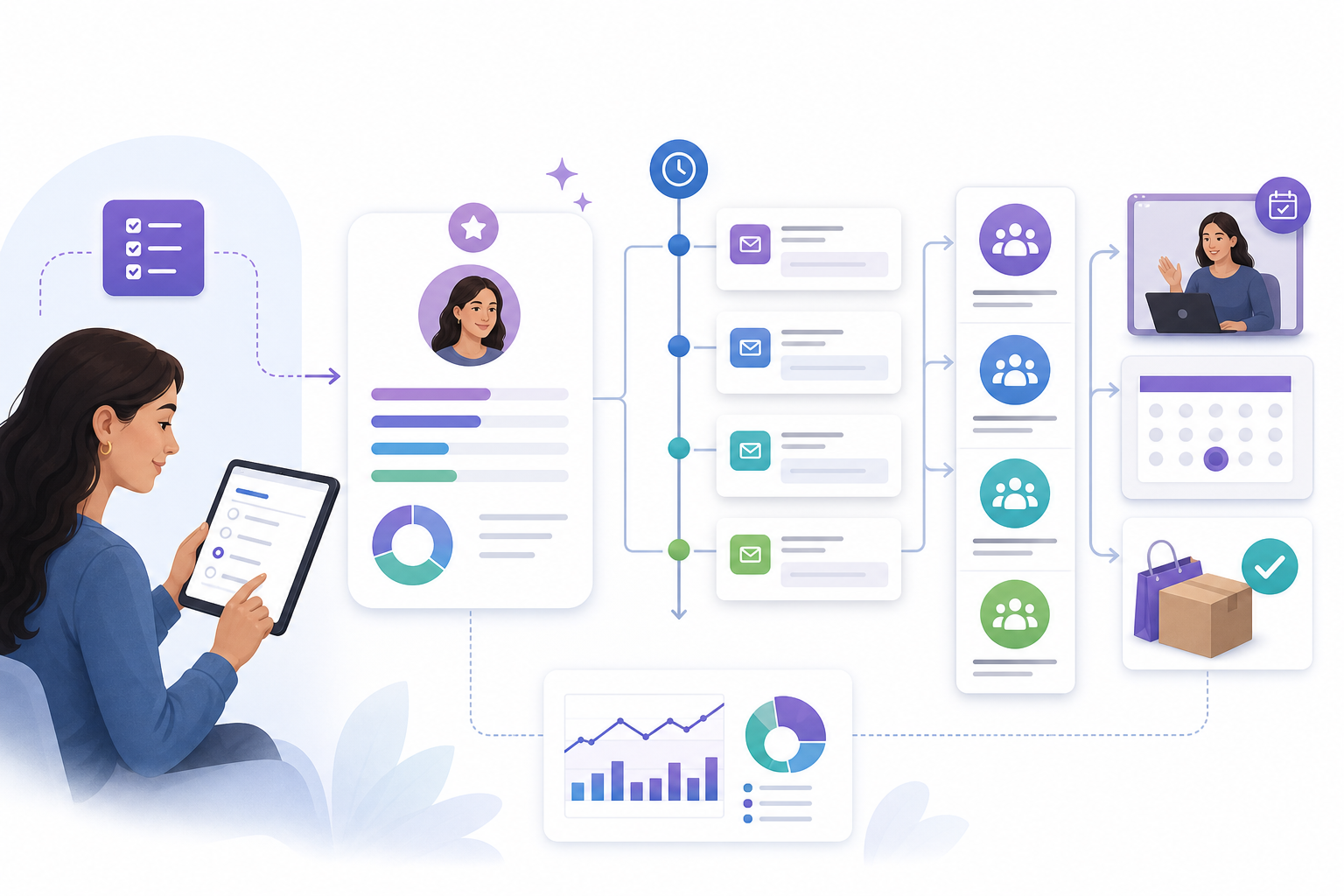
Quiz follow-up should continue the diagnosis instead of resetting to a generic newsletter. Include the person's result in the subject line or opening, repeat the core insight, deliver the promised resource, and guide the reader toward one next action.
Email 1: Deliver the result immediately
Subject: Your [result name] plan is ready
Opening: Hi [first name], your answers point to [result]. Your biggest opportunity is [opportunity], especially because you said [relevant answer pattern].
Value: Start with these three actions: [action one], [action two], and [action three].
Call to action: View your full result and next steps.
Purpose: Fulfill the promise, establish continuity, and create a durable route back to the result page.
Email 2: Reframe the primary problem
Send: One day later.
Subject: Why [common attempted solution] may not fix [problem]
Copy direction: Explain the mistake most common to this result segment. Use a short example, then recommend one diagnostic action. The goal is not to manufacture fear; it is to help the reader understand why previous efforts may have stalled.
Call to action: Use the checklist, watch a relevant walkthrough, or review the recommended approach.
Email 3: Show segment-matched evidence
Send: Two or three days later.
Subject: How a [similar customer] improved [specific outcome]
Copy direction: Present a concise case: starting situation, obstacle, intervention, measurable result, and lesson. Select evidence that corresponds to the person's use case, stage, or recommended product.
Call to action: See how the same approach would apply to your result.
Email 4: Answer the decision objection
Send: Three to five days later.
Subject: Do you need [offer] yet?
Copy direction: State who the offer is for, who should wait, what implementation requires, and what alternatives exist. Transparent disqualification can increase trust and reduce poor-fit sales calls.
Call to action: Compare options, view pricing, or reply with a question.
Email 5: Make the direct invitation
Send: Five to seven days after completion, adjusted for the normal buying cycle.
Subject: Your next step for [desired outcome]
Copy direction: Summarize the diagnosis and invite the reader to take the primary conversion action. Explain exactly what happens after the click. If there is a genuine deadline or capacity limit, state it precisely; do not invent urgency.
Call to action: Start, buy, book, request, or build.
Behavior should modify this sequence. A lead who clicks a high-intent result-page offer may receive sales-oriented follow-up sooner. A lead who does not open the result email may need a simpler resend. A person who purchases should leave the prospect sequence immediately and enter onboarding. Result segmentation without behavior-based suppression creates awkward messages and erodes confidence.
How do you test and improve a quiz funnel?
Judge the funnel as a connected system. A high start rate has little value if few visitors finish, and a high email capture rate can conceal poor lead quality. Establish an analytics baseline before changing copy, logic, design, and traffic at the same time.
Track the funnel by stage
- Start rate: Quiz starts divided by qualified views of the opening screen.
- Completion rate: Completed quizzes divided by starts.
- Question drop-off: People who leave at a question divided by people who reached it.
- Lead-capture rate: Valid form submissions divided by lead-form views.
- Result engagement: Meaningful result views or interactions divided by completed quizzes.
- Call-to-action click rate: Primary result-page clicks divided by result views.
- Qualified lead rate: Leads meeting the defined criteria divided by all captured leads.
- Sales conversion rate: Purchases or accepted opportunities divided by leads.
- Revenue per start: Attributed revenue divided by quiz starts.
Benchmarks vary sharply by traffic temperature, audience, offer, device mix, and whether lead capture is required. Treat generic benchmark claims as directional rather than universal. Your strongest benchmark is the previous version under comparable traffic conditions.
Diagnose the bottleneck before testing
If few visitors start, test the promise, specificity, traffic-message match, and expected effort. If people leave on an early question, shorten the introduction, simplify answer choices, or remove sensitive data requests. If people complete but refuse the lead form, improve the promised deliverable and clarify consent. If leads view results but do not click, strengthen the diagnosis, offer fit, proof, and call to action.
Prioritize tests using expected impact, evidence, and effort. Test one meaningful hypothesis at a time when traffic allows. A button-color experiment is rarely the best first move if the quiz promise is unclear or the recommended results all say essentially the same thing.
Run a prelaunch quality check
- Complete every major branch on mobile and desktop.
- Verify result calculations, thresholds, ties, exclusions, and fallback outcomes.
- Confirm form validation, consent, contact creation, field mapping, and duplicate handling.
- Check that each result triggers the correct email sequence and sales routing.
- Test every link, button, calendar, checkout, and download.
- Review the copy for unsupported claims, biased assumptions, and inaccessible answer labels.
- Confirm analytics events once, without accidental duplicate firing.
- Ask people unfamiliar with the project to describe what each result means and what they should do next.
A platform can simplify implementation, but it cannot repair a weak strategy. Start with the written template, confirm the decision logic, and then choose from proven templates or build the journey in GeniuzQuiz. That order keeps visual preferences from dictating the segmentation model.
For organic discovery and GEO, make the quiz's surrounding page explicit about the audience, method, result types, and expertise behind the recommendations. Clear definitions, transparent criteria, and useful result explanations are easier for search engines, AI Overviews, ChatGPT, Perplexity, and Gemini to interpret than unsupported claims of being “the best.” The funnel should remain valuable when summarized, cited, or encountered outside its original acquisition channel.
Frequently asked questions
How many questions should a quiz funnel have?
Most lead-generation quiz funnels should begin with five to eight substantive questions. That is enough to collect several useful signals without creating unnecessary fatigue. A simple product matcher may need only three or four, while a regulated eligibility assessment may require more. Include progress indicators when the path is longer, and remove any question that does not change a result, branch, qualification decision, or follow-up message.
Should I ask for an email before or after showing quiz results?
Ask for an email immediately before the full result when the outcome has clear value and email delivery is part of the promise. Show results first when trust is low, traffic is cold, or the recommendation must be experienced before the offer makes sense. A hybrid approach can reveal the result category first, then request an email to deliver the detailed plan. Test lead quantity and downstream quality, not form submissions alone.
How many quiz results should I create?
Three to five primary results are usually manageable and distinct enough for lead-generation funnels. Each result should have a recognizable diagnosis, different advice, and a logical next step. If two results lead to identical copy and offers, combine them. If one result covers incompatible situations, split it or use a secondary readiness segment to personalize the follow-up.
What is the difference between branching logic and scoring?
Branching logic changes what happens next based on a particular answer, such as showing a different question or excluding an ineligible product. Scoring assigns numerical or category values to answers and calculates an outcome after several responses. Use branching for decisive conditions and scoring for patterns that emerge across multiple answers. Many effective funnels use both.
Can a quiz funnel work without selling a product immediately?
Yes. A quiz can qualify consultation leads, segment subscribers, recommend educational content, identify customer needs, route support requests, or prepare prospects for a later purchase. The commercial next step should match buying readiness. Early-stage visitors may need a plan or comparison, while high-intent visitors may be ready for a trial, quote, checkout, or appointment.
How do I prevent quiz results from feeling generic?
Reference two or three meaningful answer patterns, explain the tradeoff behind the recommendation, and prescribe actions specific to the result. Avoid relying on a flattering label alone. The visitor should understand why the result was assigned, what to do now, what to avoid, and when another option would be more appropriate.
What makes quiz funnel follow-up persuasive rather than spammy?
Persuasive follow-up continues the promised diagnosis, uses the person's result accurately, and sends information appropriate to that person's stage. It becomes spammy when every segment receives the same pitch, when urgency is fabricated, or when the email frequency and content were not disclosed. Give subscribers a clear expectation, suppress irrelevant messages, and make each email useful even before the reader buys.